An authorized retailer, not a marketplace guess
Goglycobarrier is the USA Authorized GlycoBarrier Retailer. You are buying from a named US business with a published office address, not from a reseller listing you cannot trace.
Official product information
GlycoBarrier is a dietary supplement sold as liquid drops in a 2 FL OZ / 60ML amber glass bottle, distributed by Vitalifes. The Supplement Facts panel prints a 2 mL serving, 30 servings a bottle and a 121 mg proprietary blend of six botanical extracts. The directions read “shake bottle well, take 1ml twice daily”. No individual ingredient amount is published, and no pack price was supplied to us, so every price here reads “at checkout”.
Sold by Goglycobarrier, USA Authorized GlycoBarrier Retailer · Order desk +1 (302) 200-3480 · Read the whole panel



 Marks describe the packaging. They are not an endorsement, and no supplement
is FDA approved. What each one means
Marks describe the packaging. They are not an endorsement, and no supplement
is FDA approved. What each one means
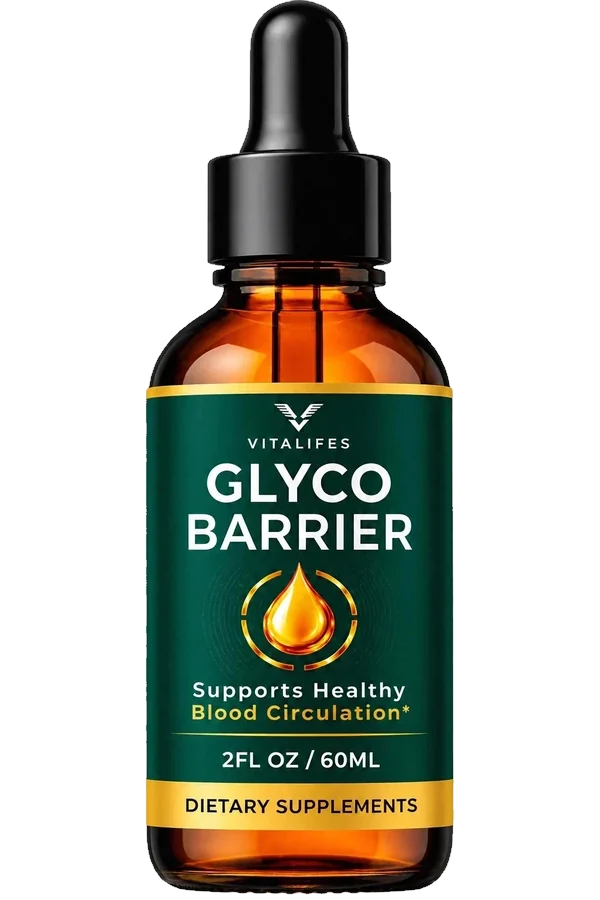
Supports Healthy Blood Circulation*

The short version
Twenty rows, every one of them read off the bottle or the seller’s own pack. Where a figure does not exist, the row says so.
GlycoBarrier in 60 seconds
GlycoBarrier is a dietary supplement sold as liquid drops, 2 FL OZ / 60ML in an amber glass dropper bottle, distributed by Vitalifes. The Supplement Facts panel prints a 2 mL serving size, 30 servings a bottle and a 121 mg proprietary blend containing gotu kola, Chinese hawthorn, horse chestnut, motherwort, butcher’s broom and grape seed extracts. The directions are 1 mL twice daily. No individual ingredient amount is published. No pack price was supplied, so prices show at checkout, and no money-back window length is published anywhere in our sources.
121 mg blend. 30 servings a bottle. Six named botanicals. Pack prices and the money-back window are printed on the listing, not here, because neither was supplied to us.
See the three packsStart here
People come to this category for ordinary, physical reasons. Legs that ache by the evening. Ankles that mark when the socks come off. Hands that go cold before anyone else’s do. A sense that the body is moving blood around less willingly than it used to.
Those things have causes, and a dropper bottle is not the first place to look for them. The American Heart Association describes cardiovascular disease as a group of conditions in which plaque narrows the arteries and restricts blood flow through the body. MedlinePlus covers varicose veins as a medical topic with medical options, from compression through to procedures. Both are worth reading before any supplement page, including this one.
That matters here more than usual, because the one ingredient on this label with a genuine controlled-trial record — horse chestnut seed extract — was studied in chronic venous insufficiency. That is a diagnosis, made by a clinician, not a feeling you have at the end of a long day. If that is what is going on, a diagnosis will do more for you than drops will.
What a supplement can honestly offer is smaller: a daily habit built around botanicals with long traditional use and, in three cases, federal health pages you can actually read. That is the market GlycoBarrier sits in. Knowing the size of the claim before you read the rest of this page is the most useful thing we can give you.
The product
GlycoBarrier is a liquid supplement. It arrives as 2 FL OZ / 60ML of amber-coloured liquid in amber glass, with a black rubber-bulb pipette in the cap. You shake it, draw up 1 mL and take it, twice a day.
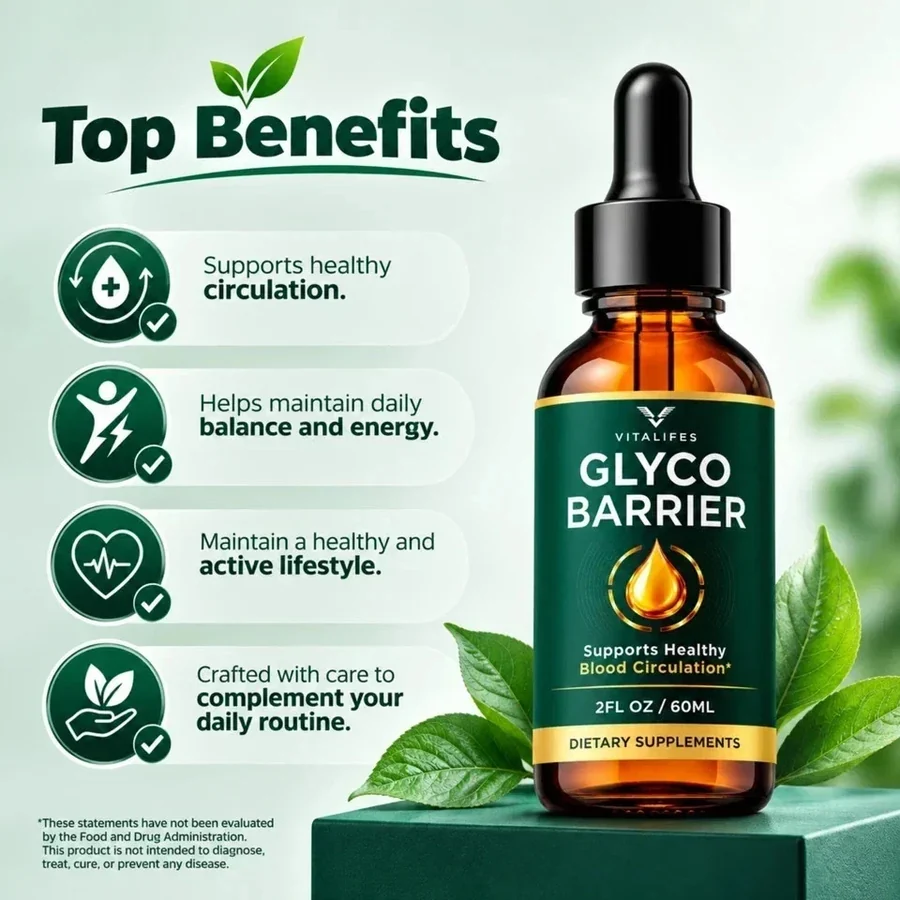
The front of the bottle carries the maker’s mark and the word VITALIFES, the product name GLYCO BARRIER across two lines, a gold droplet device, the claim “Supports Healthy Blood Circulation*”, the volume 2FL OZ / 60ML and the words DIETARY SUPPLEMENTS in a gold band at the foot.
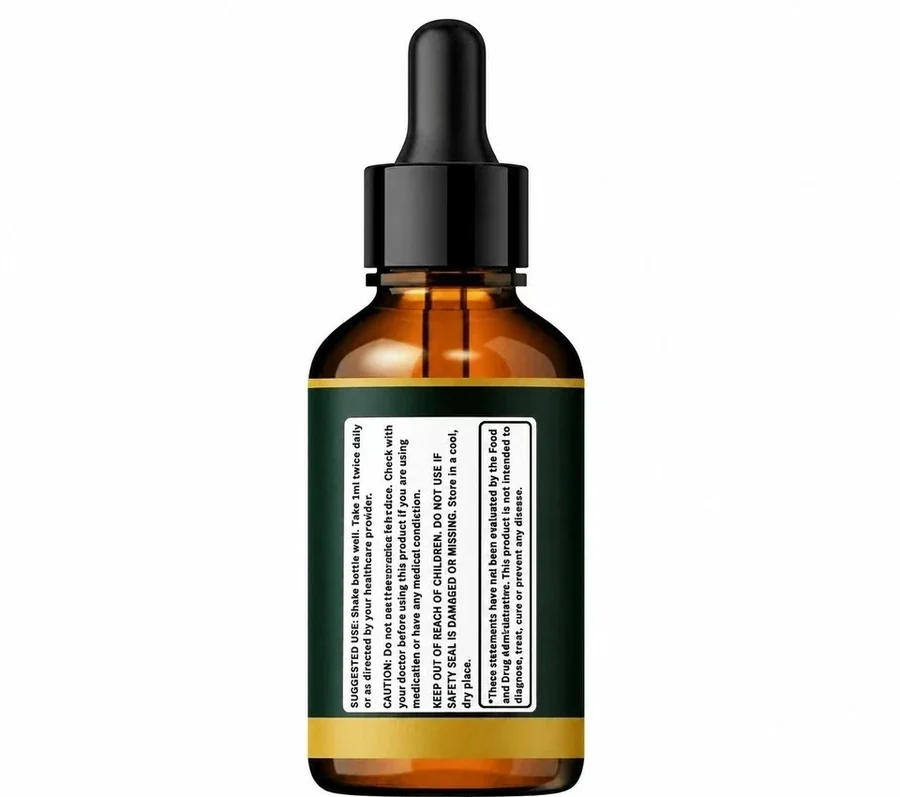
Turn it round and there is something this category often does not provide: a real Supplement Facts panel. Serving size 2 mL. Servings per container 30. Proprietary Blend 121 mg. Six extracts named underneath it, a Daily Value footnote, a full other-ingredients list and a distributor line. Turn it again and the side panel prints the directions and the warnings.
Here is the sentence this site exists to say clearly: 121 mg is the total for the whole proprietary blend, not the amount of each ingredient. How it divides six ways is not published anywhere. Everything else on this page is written with that in mind.
Buying here
Six reasons, and the last two are the reason to trust the first four.
Goglycobarrier is the USA Authorized GlycoBarrier Retailer. You are buying from a named US business with a published office address, not from a reseller listing you cannot trace.
+1 (302) 200-3480, for orders, tracking, changes and refunds. Most supplement sites in this category publish a web form and nothing else.
3 Times Square, Floor 12, New York, NY 10036, USA. It is on this site rather than hidden behind a support ticket, and it is a different address from the office, which is normal and worth knowing before you post anything.
[email protected], Monday to Friday, 9:00am - 5:00pm ET. It handles this site: corrections, privacy and press. It cannot see orders, and we say so rather than letting you wait.
Four sections of this site exist to tell you what is missing from this label and from this category, including six misprints on the artwork. A page that only flatters a product is advertising.
Four of the eight named buyers in the material we were given say the same sentence word for word. We publish the seller’s figures as the seller’s figures, and no testimony at all.
Mechanism
Six steps. Five of them are real, and the sixth is the one the word “proprietary” makes impossible.
A botanical extract suspended in water and vegetable glycerin separates between doses. “Shake bottle well” is the first instruction on the label for a reason: an unshaken bottle gives you a weak dose at the start of the month and a strong one at the end of it.
1 mL in the morning, 1 mL later. Liquids need no shell to break down and no water to swallow, and a dropper held under the tongue is the fastest daily supplement routine there is. That is the honest practical headline for this form.
121 mg of proprietary blend across gotu kola, Chinese hawthorn, horse chestnut, motherwort, butcher’s broom and grape seed. The panel lists them in descending order by weight, which is the one thing a proprietary blend still tells you: gotu kola is the largest share and grape seed the smallest.
Horse chestnut and butcher’s broom are the pairing European preparations have used for leg-vein complaints for decades. NCCIH describes a 2012 review in which horse chestnut seed extract improved symptoms of chronic venous insufficiency, with one study finding it comparable to compression stockings. That is the strongest evidence anywhere near this label.
Chinese hawthorn and motherwort. NCCIH reports hawthorn has been studied for heart failure and blood pressure, that some studies suggest a benefit as an add-on, and that the evidence is not strong enough to settle it. Motherwort’s own species name, cardiaca, records what it was traditionally used for.
Working out whether 121 mg is enough of anything. NCCIH says plainly that research on grape seed extract has not shown it helpful for any health condition. Horse chestnut’s own evidence rests on a standardised seed extract, and this label does not say whether that is what is in the bottle. Two unknowns stack on top of each other here.
We are not going to describe a mechanism for GlycoBarrier in the body, because no study of this formula exists and the ingredient split is not published. Read this section as a map of what the formula is built from, not as a claim about what it does for you.
The formula
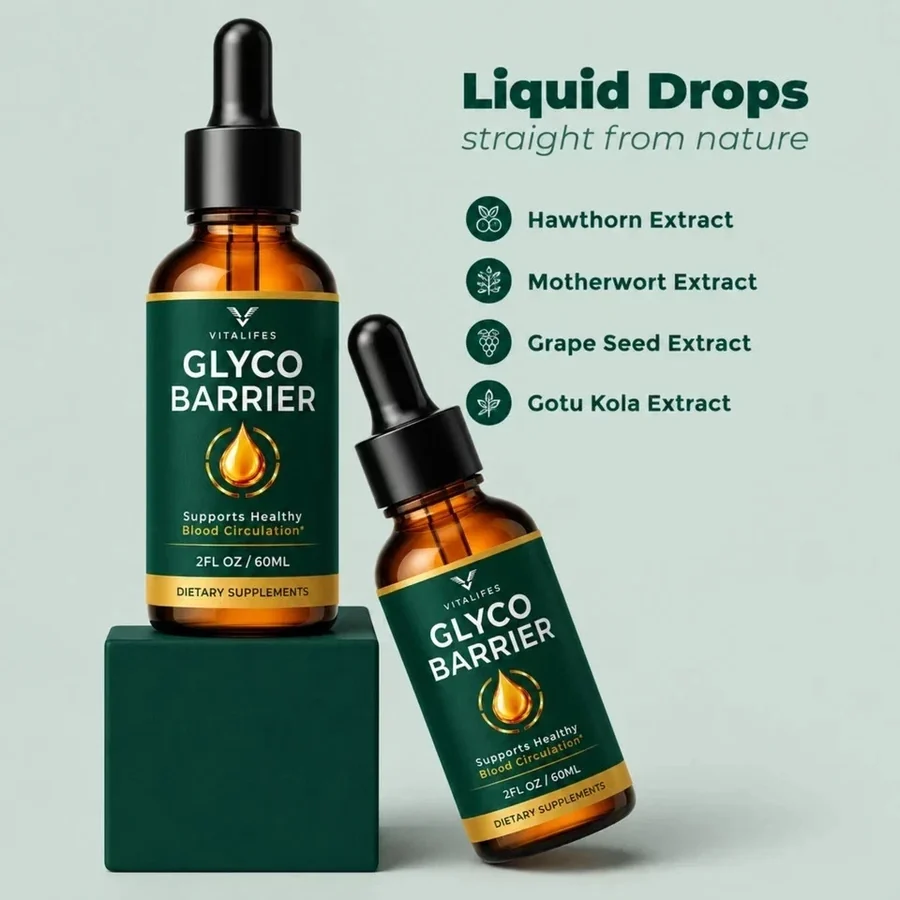
Six named, in the order the Supplement Facts panel prints them, which is descending order by weight.
Gotu kola extract
First in the blend, and the one with the thinnest US evidence file.
Gotu kola (Centella asiatica) is a small creeping plant from wet ground across Asia. The leaf is the part used, and the label says so - “(leaf)” is printed after the name.
It is the traditional circulation herb of the group, used in Ayurvedic and Chinese practice for what would now be called venous complaints. NCCIH’s Herbs at a Glance index covers about sixty herbs and gotu kola is not among them, which tells you how thin the mainstream review literature is.
Amount in GlycoBarrier: not published Research reference: No agreed research dose
Chinese hawthorn extract
The cardiovascular name on the label, and the best-researched one.
Hawthorn is a thorny shrub in the rose family. This label names the Chinese species and specifies the fruit, which is the part eaten as a food in China and used in the traditional preparations.
NCCIH’s hawthorn page is the reason this ingredient is here. It reports that hawthorn has been studied for heart failure and blood pressure, that some studies suggest benefit as an add-on in heart failure, and that the evidence overall is not strong enough to settle the question.
Amount in GlycoBarrier: not published Research reference: Trials commonly use standardised leaf-and-flower extract, hundreds of milligrams daily
Horse chestnut extract
The one ingredient here with a genuine controlled-trial record.
Horse chestnut (Aesculus hippocastanum) is a European tree. Supplements use an extract of the seed. The label does not print which part this extract came from, and that omission matters more here than anywhere else on the panel.
NCCIH describes a 2012 review of horse chestnut seed extract for chronic venous insufficiency: the extract improved symptoms such as leg pain, swelling and itching, and one study found it comparable to compression stockings. That is a real finding, and it is the strongest thing anyone can say about this blend.
Amount in GlycoBarrier: not published Research reference: Standardised seed extract, typically taken daily for weeks in trials
Motherwort extract
A mint-family herb with a long name in cardiac folk use.
Motherwort (Leonurus cardiaca) is a member of the mint family. The species name cardiaca is itself a record of what it was traditionally used for.
It belongs to the same traditional grouping as hawthorn, which is why the two keep appearing together. Controlled human research is sparse, and the label does not print an amount.
Amount in GlycoBarrier: not published Research reference: No agreed research dose
Butcher’s broom extract
The second venous herb, and the second one NCCIH does not index.
Butcher’s broom (Ruscus aculeatus) is a low evergreen shrub from the Mediterranean. The root and rhizome are the parts used, and the label specifies “(root)”.
It is a standard component of European venous-tone preparations and is often combined with horse chestnut for that reason. Like gotu kola, it is not among the roughly sixty herbs in NCCIH’s Herbs at a Glance index, so there is no plain-language federal summary to point you at.
Amount in GlycoBarrier: not published Research reference: No agreed research dose
Grape seed extract
The antioxidant name, and the one with the clearest federal page.
Grape seed extract is made from the seeds left after winemaking. It is rich in proanthocyanidins, a class of plant compound.
NCCIH’s page on grape seed extract is direct: it has been studied for conditions including cardiovascular disease, and the research so far has not shown it to be helpful for any health condition. It also notes it is generally well tolerated.
Amount in GlycoBarrier: not published Research reference: Trials have used a wide range; no single agreed amount
Tap any ingredient to open it. Every card ends the same way, because the panel ends the same way. Read the full ingredient page →
The honest section
GlycoBarrier publishes more than most of this category does — a real Supplement Facts panel with a declared blend total, a printed serving size and a printed dose. What it does not publish is how that total divides. So a dose-versus-research comparison can be made for the blend as a whole, and cannot be made for any single ingredient in it.
| What | Amount in GlycoBarrier | Research reference | Our reading |
|---|---|---|---|
| The whole proprietary blend | 121 mg a serving | Six botanical extracts share it | This is the only amount published anywhere on the bottle. |
| Gotu kola extract (leaf) | not published | No agreed research dose | Share of the 121 mg is unknown. |
| Chinese hawthorn extract (fruit) | not published | Trials use hundreds of mg of a standardised extract | One ingredient in a trial can exceed this whole blend. |
| Horse chestnut extract | not published | Standardised seed extract, daily for weeks in trials | The label does not name the plant part or the standardisation. |
| Motherwort extract | not published | No agreed research dose | Share of the 121 mg is unknown. |
| Butcher’s broom extract (root) | not published | No agreed research dose | Share of the 121 mg is unknown. |
| Grape seed extract | not published | No single agreed amount in trials | NCCIH reports no condition it has been shown to help. |
Do the arithmetic in the other direction and it gets clearer. If the 121 mg were split evenly — and the descending-order rule tells us it is not — each extract would carry about 20 mg. Published hawthorn work uses hundreds of milligrams of a single standardised extract. Horse chestnut trials use a standardised seed extract taken daily over weeks.
Across a whole day you take two servings, so the daily figure is 242 mg of blend. That is the most generous way to state it, and it is still one number split six ways.
That is not an accusation. Plenty of formulas are built to be a daily habit rather than a clinical dose, and the label never claims otherwise — it says supports, which is exactly the modest wording US law allows, and it carries the FDA footnote. It does mean you should buy this as a habit, not as a strength.
The label
Three lines, six extracts, seven other ingredients — and nine things that are not there.
Unlike most products in this category, GlycoBarrier prints a full Supplement Facts panel. Here it is, transcribed off the bottle shot supplied in the assets.
*Daily Value Not Established. Distributed by — Vitalifes. EXP 12/2028.
The horse chestnut plant part. NCCIH is explicit that raw horse chestnut seeds, bark, flowers and leaves are unsafe to swallow, and that properly processed standardised extract has the toxic component removed. The panel prints two words and no standardisation.
Claims
One claim on the bottle, four on the seller’s panel, and then the list most pages in this category leave out.
The claim printed on the front of the bottle, with the asterisk that ties it to the FDA footnote. “Supports” is the modest, legal wording for a supplement, and horse chestnut is the ingredient with the best claim to it.
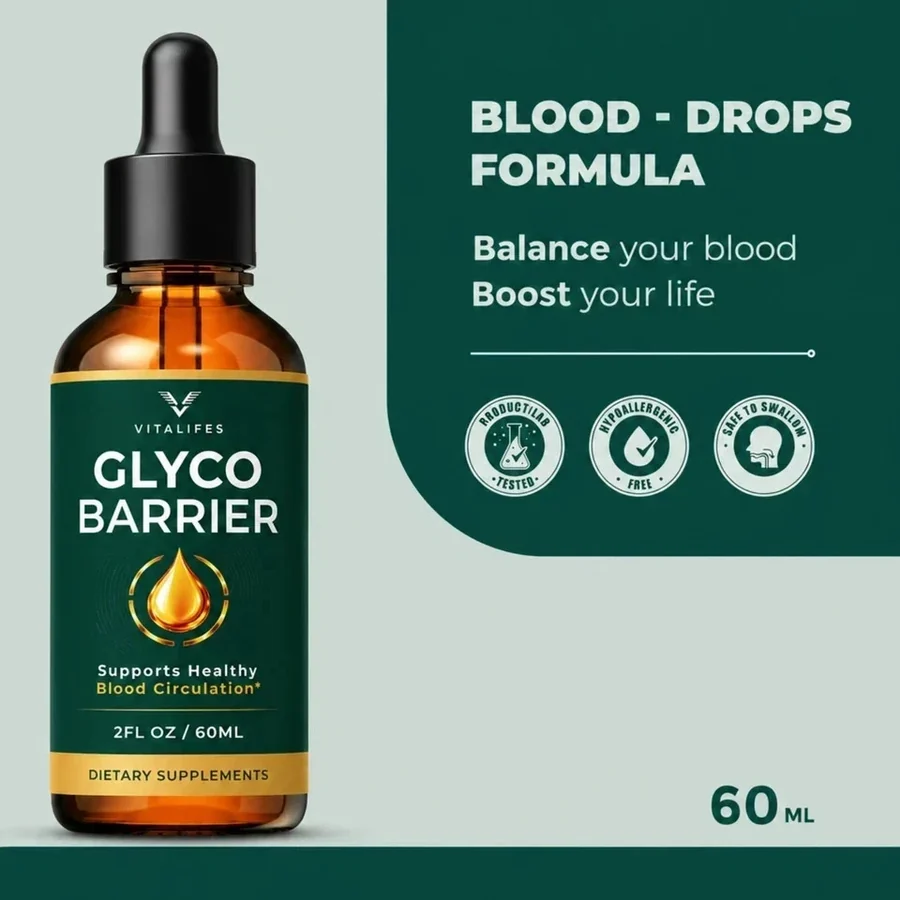
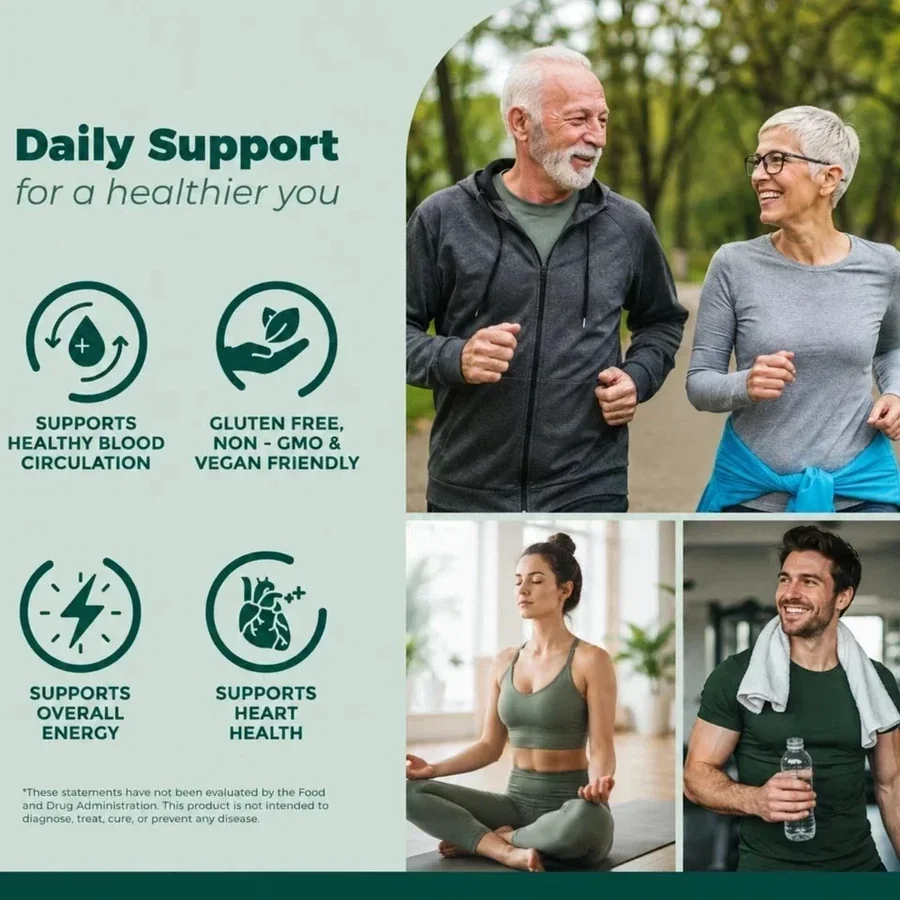
From the seller’s Daily Support panel, not from the bottle. Nothing on this label is allowed to promise a change, and nothing here does. Read it as what the formula is offered for rather than what it delivers.
Also from the Daily Support panel. Hawthorn is the ingredient behind it. NCCIH reports the evidence is not strong enough to settle the question, which is worth holding alongside the icon.
Not a label claim, and the most defensible practical benefit here. “Shake bottle well. Take 1ml twice daily” is more instruction than a surprising number of dropper products give you.
Quoted from the material supplied to us. All four are structure/function claims, which is what US law permits a supplement to say.
It does not treat, prevent or cure varicose veins, chronic venous insufficiency, cardiovascular disease, diabetes or any other condition. Despite the “Glyco” in the name, nothing on this label claims anything about blood sugar. It does not replace prescribed medicine. It is not FDA approved, because no dietary supplement is. It has no published timeline and no trial of its own.
The honest section
Eight each. The right-hand column is the one worth reading twice.
Fit
The form is the honest headline. Drops go under the tongue in about four seconds, and a supplement you actually take beats a stronger capsule that stays in the drawer.
A printed serving size, a printed serving count, a printed dose and a bottle volume that agrees with all three. That is a low bar and most of this category trips over it.
Six botanicals are named in blend order, with the plant part given for three of them. The total is declared. What is missing is the split, not the list.
Grape seed extract may slow blood clotting. Hawthorn can interact with heart medicines including digoxin. This is a conversation with a pharmacist before your first dose, not after.
Motherwort is traditionally used to stimulate the uterus, which is a reason to avoid it in pregnancy. The label is for adults 18 and over, and there is no safety data here for pregnancy either way.
MedlinePlus lists varicose veins among the conditions a clinician should see, and horse chestnut’s own research record is in chronic venous insufficiency - a diagnosis, not a feeling. A supplement can delay that appointment by months.
The 121 mg total is published; how it divides across six ingredients is not. If that matters to you, and it reasonably might, this panel will not satisfy you.
Daily routine
Six steps, and the first one matters more on a tincture than on any capsule you have taken.
Not a swirl. Ten seconds, hard enough to see the liquid move against the glass. A botanical extract in water and glycerin settles between doses, and this is the step people skip.
Most glass pipettes carry a graduation. Use the mark rather than counting drops, because drop size changes with the liquid and with how you hold it. If your dropper has no mark, call the order desk on +1 (302) 200-3480 before you guess.
The label says twice daily and gives no times. Anchor both doses to something you already do without deciding — the first coffee and brushing your teeth at night are the two that hold for most people.
The bottle prints this itself, in capitals, on the side panel. More of a botanical blend is not better, and with hawthorn and grape seed in the formula it is not a harmless experiment either.
The label says store in a cool, dry place. Amber glass is used to keep light out, so a cupboard beats a windowsill, and a clean dropper stops the pipette gumming up towards the end of the bottle.
Not on your first dose. No window length was supplied to us, so read it on the listing before you pay and screenshot it — a parcel that sits unopened for ten days has already spent part of a window you cannot see.
Take the next one as normal. Do not double up to catch up. There is no loading dose here and nothing to make up.
Format
One form only. GlycoBarrier is liquid drops in a 2 FL OZ / 60ML amber glass bottle with a rubber-bulb pipette in the cap. There is no capsule, tablet or powder version in the material we were given, and no larger or smaller bottle.
Three things follow from that. The first is the obvious one: there is nothing to swallow. For anyone who has abandoned a supplement because of the capsules, that is not a marketing point, it is the reason the product might actually get used.
The second is that a liquid is measured rather than counted. A capsule is a fixed amount whether you are paying attention or not; 1 mL from a pipette is only a fixed amount if you use the mark. That is a small extra demand the form makes on you twice a day, and it is worth knowing before you buy six bottles.
The third is that the bottle tells you what the base is, which is more than most gummies and capsules manage. RO water, vegetable glycerin, natural flavor, sodium benzoate, potassium sorbate, malic acid and sucralose — a full other-ingredients line, printed on the panel. If you avoid sucralose, you can find that out before you order rather than after.
The amber glass is doing a job too. Botanical extracts degrade in light, which is why tinctures are not sold in clear bottles, and it is why the label says to store it in a cool, dry place rather than on a sunny shelf.
If you want the longer version of the millilitre argument, it is in the blog.
Category
| What you are comparing | GlycoBarrier | Typical of the category |
|---|---|---|
| Form | GlycoBarrier: liquid drops | Most circulation supplements: capsule |
| Serving size printed | Yes - 2 mL | Usually yes |
| Directions printed | Yes - 1 mL twice daily | Usually yes |
| Bottle arithmetic | Checks out - 60 mL at 2 mL a day is 30 servings | Rarely worth checking |
| Blend total published | Yes - 121 mg | Often not published at all |
| Individual amounts | No - “Proprietary Blend” | Varies - the better labels publish a full panel |
| Ingredients named | 6, in blend order | Often 1 to 3, sometimes none |
| Strength against research | 121 mg across six ingredients | Single-ingredient products often use hundreds of milligrams |
| Third-party test published | No - reference codes only | Uncommon, but the best labels publish one |
| Money-back window | Length not published | 30 to 90 days |
| Published price | None - shown at checkout | Usually published |
| Phone support | Yes, +1 (302) 200-3480 | Often email only |
| Row | What it means for a buyer |
|---|---|
| Form | Drops absorb from the mouth and need no swallowing, which is the main practical argument for them. |
| Serving size printed | An ordinary label line, and it is here. |
| Directions printed | This one is worth checking: a surprising number of dropper products print a strength and no instruction. |
| Bottle arithmetic | When the numbers on a label agree with each other, somebody read the label before it went to print. |
| Blend total published | GlycoBarrier is ahead of the category here, and it is worth saying. |
| Individual amounts | This is where the panel stops being useful. |
| Ingredients named | Six named botanicals inside a declared total is more disclosure than most. |
| Strength against research | The honest gap, and the reason our strength score is a three. |
| Third-party test published | A code is not a document. |
| Money-back window | The weakest line in the table, and the easiest one to fix. |
| Published price | The weakest part of the buying experience here. |
| Phone support | A real strength. |
The pattern across twelve rows: GlycoBarrier is unusually good on label mechanics — a real panel, a printed dose, numbers that agree with each other — and on support, and behind on strength, price visibility and the refund window. Most of this category publishes no milligram figure at all, so the number on this bottle is worth something. It is just a small number split six ways, and you should know that before you pay rather than after.
Packs
Three pack sizes. No price, because none was supplied to us — and a guessed price you are then charged something else for is worse than none.
Smallest pack
60 mL total · 30 servings
30 days at the label dose
Most ordered, per the seller
180 mL total · 90 servings
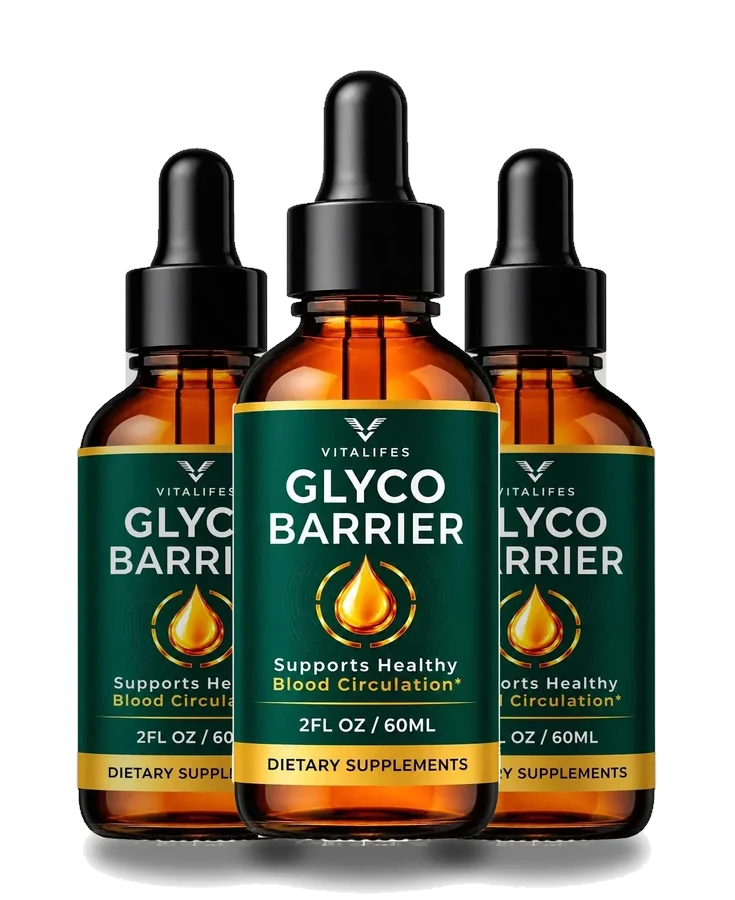
90 days at the label dose
Largest pack
360 mL total · 180 servings
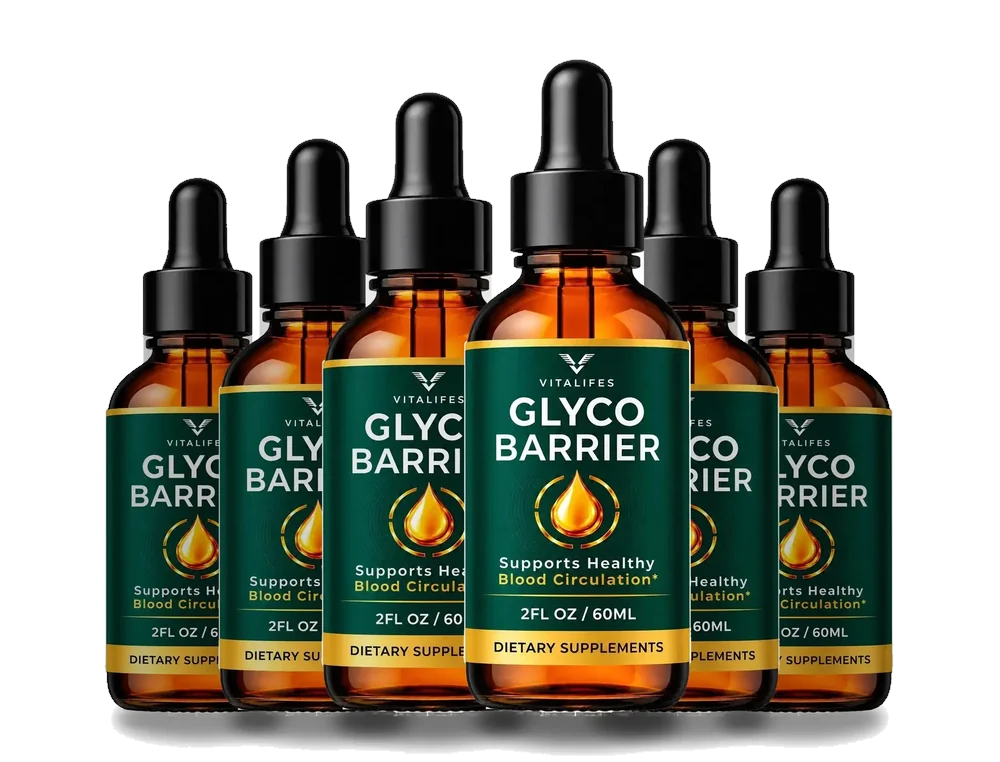
180 days at the label dose
No pack price was supplied to us, so every price on this site reads “shown at checkout”. The figure you will actually be charged is printed on the marketplace listing, and that is the only place it appears. We would rather say that than estimate a number.
The honest section
| Pack | Bottles | Total volume | Servings | Days at the label dose | Cost a day |
|---|---|---|---|---|---|
| Single bottle | 1 | 60 mL | 30 | 30 | at checkout |
| Three-bottle pack | 3 | 180 mL | 90 | 90 | at checkout |
| Six-bottle pack | 6 | 360 mL | 180 | 180 | at checkout |
The single bottle. Thirty days at the label dose is long enough to know whether the twice-a-day routine survives contact with your actual life, and short enough that you are not sitting on five unopened bottles inside a refund window whose length nobody has published.
The six-bottle pack is 180 days of product. Against an unknown window that is a substantial bet on a formula with no trial behind it. If it works for you, the larger pack is still there in a month. The saving does not expire; the window does — and you cannot currently see when.
Notice what is missing from that table. One column depends on a price no page publishes before checkout, and the decision above depends on a window length that appears in none of our sources. Those are two ordinary commercial lines, and both are absent.
The arithmetic that is available is unusually clean, and worth saying out loud: 60 mL at 2 mL a day is exactly 30 days, and the panel declares exactly 30 servings. When a label’s own numbers agree with each other, somebody checked it before it printed.
Safety
| If you take… | Because of… | What to do |
|---|---|---|
| A blood thinner, or aspirin daily | Grape seed extract | It may slow blood clotting. This is the first combination to raise with a pharmacist, and it takes them under a minute. |
| Digoxin or another heart medicine | Chinese hawthorn | Hawthorn can interact with heart medicines. Do not start it alongside one without asking. |
| Blood-pressure medicine | Hawthorn and butcher’s broom | Both have been used traditionally for vascular tone. Ask before adding them to a stable prescription. |
| Surgery booked in the next fortnight | Grape seed extract | Tell the surgical team what you are taking. Anything that may affect clotting belongs on that list. |
| Pregnancy or breastfeeding | Motherwort | Traditionally used to stimulate the uterus. Not for use in pregnancy, and there is no safety data here either way. |
| A liquid you cannot identify the parts of | Horse chestnut | NCCIH says raw horse chestnut seeds, bark, flowers and leaves are unsafe to swallow, and that properly processed extract has the toxic component removed. The panel does not say which this is. Ask the order desk. |
| Any regular medicine at all | The formula as a whole | The bottle’s own instruction: check with your doctor before using this product if you are using medication or have any medical condition. |
The horse chestnut. NCCIH is unambiguous that raw horse chestnut seeds, bark, flowers and leaves are unsafe to swallow because they contain a toxic component, and that a properly processed standardised extract has that component removed and is considered safe for short-term use. This panel prints “Horse Chestnut Extract” and nothing else — no plant part, no standardisation. That is an ordinary label line and it is missing, and it is worth a call to +1 (302) 200-3480 before a first bottle rather than after.
There is no published laboratory report for GlycoBarrier. Lot GLY-26/GO-2426 and certificate GLY-2426-26-GO are reference codes, supplied without any document behind them, so nobody outside the manufacturer can check what is in the liquid or confirm the extract preparations.
That is not an allegation about this product. It is the reason the honest sections on this site exist, and the reason we print the six misprints on the artwork rather than tidying them away. What the codes are and are not →
No side effects are published for this product. Botanical tinctures most often cause mild stomach upset or a reaction to the taste. Anything beyond that is worth reporting to the order desk on +1 (302) 200-3480 and to your own clinician. Read the full safety page →
Expectations
Days 1-7
Drops are the easiest thing in the world to take and the easiest thing to forget at nine at night. The only job in week one is anchoring both doses to something you already do without deciding.
Nothing is published about what week one does.
Weeks 2-4
Four weeks is about the shortest honest window for a daily botanical. That is also roughly one bottle, which makes it a natural checkpoint: you will be deciding whether to reorder anyway.
No trial of this formula exists to compare against.
Weeks 4-8
The seller’s own listing says most buyers waited three to six weeks. Take that as a description of expectation, not of effect, and note that a refund window of unknown length is running somewhere inside it.
The window runs from purchase, not from your first dose.
After 8 weeks
If nothing has changed after two months of twice-daily use, that is an answer. It is also the point at which a clinician is a better use of the money.
Leg swelling, pain and visible vein changes have medical causes worth ruling out.
No timeline is published for GlycoBarrier as a policy, no trial of it exists, and this site publishes no buyer testimony to draw a curve from. So instead of a graph, this is a plan: four weeks to a first fair look, eight weeks to a decision, and a refund window of unknown length running somewhere inside both.
One bottle is exactly thirty days at the label dose, which makes the reorder decision and the first fair look land on the same date. Use that. Write down on day one the one thing you would want to be different at four weeks, and be specific — memory is generous to things we paid for, and a sentence you wrote before you started is the only honest comparison available. The week-by-week page →
Straight answer
No. GlycoBarrier is a real product with a named distributor on the label, a real seller, a real phone number and a published returns address in New York. Goglycobarrier is the USA Authorized GlycoBarrier Retailer, and yes, it is for sale here — every buy button on this site goes to one order page.
The question is asked constantly in this category, and it has earned the asking. This is a market with no prices on product pages, refund windows that are pointed at rather than stated, invented five-star reviews and countdown timers that reset when you reload.
So rather than tell you we are different, here are four things you can check in under five minutes, on this site or on any other:
We would rather you buy nothing than buy from a page that fails those four checks, including this one.
Buying
Through the order page on this site. Goglycobarrier is the USA Authorized GlycoBarrier Retailer, which means we hold stock and sell it in the United States. Orders ship from inside the US and a tracking number arrives in the order email.
We cannot tell you what is in a bottle bought somewhere else — not because we doubt every reseller, but because a lot number is only traceable by the company that shipped it, and a refund route only works through the desk that took the order.
The lot and best-before are printed on the base when the bottle carries them, and the panel itself prints EXP 12/2028. The lot we hold is GLY-26/GO-2426 and the certificate reference is GLY-2426-26-GO. Both are reference codes rather than lab results, and the batch page says so in its first paragraph.
Check the safety seal before anything else. The label is explicit: do not use it if the seal is damaged or missing.
Buyers
The seller publishes a score and some counts. We publish those as the seller’s, and we do not publish the eight named buyers at all.
The seller’s figures, not ours
The pack we were given lists eight buyers by first name, age and city. Four of those eight carry the same sentence, word for word: “Fair at a month. Wanted more in week one.” Three more share a second sentence the same way. That is layout copy with names typed over it, not eight people, and publishing it as testimony would be inventing customers. So this page carries none of it, and the structured data on this site contains no rating.
How we source a factThe honest section
Six questions the order desk gets, answered as they were asked. We agree with five of them.
Six extracts, in unknown proportions. If they were even - and nothing says they are - that is about 20 mg each. Published work on horse chestnut and hawthorn uses standardised single extracts at far larger amounts.
Because US rules allow it. A manufacturer may declare a blend total instead of each ingredient, provided the ingredients are listed in descending order by weight. It is legal, it is common, and it is the single thing that stops this panel being genuinely good.
Because none was supplied to us. Estimating one and having you charged something else at checkout would be worse than saying so.
We do not know, and that is not a satisfying answer. The pack says only “as printed on the marketplace listing”. Read it there, screenshot it, and keep the order email.
There are none on this site. The review block we were given has four different named buyers saying the same sentence word for word, so we publish none of it.
It is a fair thing to notice and we list all six on the fact sheet. Misprinted artwork is a quality-control signal about the printing, not evidence about the liquid. It is a reason to read the panel carefully, not a reason to panic.
Refunds
There is a money-back seal on the packaging, and the supplied pack says the guarantee is “as printed on the marketplace listing”. The supplied pack says the guarantee is “as printed on the marketplace listing” and gives no number of days. The seller’s own review summary mentions a 60-day window, but no policy text states it, so we do not print it as fact. Read the window on the listing before you pay, and screenshot it.
The website desk at [email protected] cannot see orders and cannot process a refund. Use the phone line.
Refunds are credited 3 to 5 business days after the order desk approves them, then 5 to 10 days for the card to post it.
Return postage is the buyer’s, and the window runs from purchase rather than from your first dose. Both are normal for this category, and both are worth knowing before you buy six bottles.
This is the one thing we would most want fixed about this product, so it is the one piece of advice worth repeating. Nothing supplied to us states how long the window is. Read it on the listing at the moment you pay, screenshot it with the date visible, and keep it with the order email.
The honest section
Eight marks out of ten, averaged. 5.2 is a middling score, and a page that gave this label an eight would not be worth reading.
| What we scored | Mark | Why |
|---|---|---|
| Label transparency | 6/10 | A real Supplement Facts panel with a declared 121 mg blend, a printed serving size, a printed serving count and a full other-ingredients list. That is genuinely above this category. It stops at the word “proprietary”. |
| Dosing clarity | 9/10 | “Shake bottle well. Take 1ml twice daily.” A printed instruction, and the arithmetic checks out: 2 mL a day into a 60 mL bottle is the 30 servings the panel declares. Very few labels in this category survive that check. |
| Strength for the category | 3/10 | 121 mg split six ways. Horse chestnut seed extract trials use a standardised extract daily for weeks; hawthorn trials use hundreds of milligrams of one extract. Six botanicals inside 121 mg leaves each one small. |
| Price clarity | 2/10 | No pack price was supplied to us at all. Every figure on this site reads “at checkout”, which is the weakest position a buyer can shop from. |
| Money-back window | 4/10 | A money-back seal is printed on the packaging, but no supplied document states how long the window is. “As printed on the marketplace listing” is a pointer, not a policy, and it is the one thing we would most want fixed. |
| Support and contact | 9/10 | A US phone line, a website email with published hours, a named office and a separate returns address. Most supplements in this category publish far less. |
| Published evidence for this formula | 2/10 | No trial of this blend has been published. Every reference on this site is about a single ingredient, usually at a larger amount and a different preparation. |
| Ease of daily use | 7/10 | Drops are quick, but they are not effortless: the bottle has to be shaken, the dropper has to be measured to 1 mL, and it has to happen twice a day rather than once. |
E-E-A-T
Goglycobarrier publishes this website. We are the USA Authorized GlycoBarrier Retailer, we hold stock, and we earn money when an order is placed through this site. That belongs near the top rather than in small type at the bottom, because everything else here should be read with it in mind.
Pages are written and reviewed by the GlycoBarrier Editorial Desk, which is a team rather than a person. No individual doctor or reviewer is named on this site. That is deliberate: naming a clinician we could not verify would be worse than naming none, and we apply the same standard to the “product / lab tested” roundel on this packaging, which we call unsupported on the testing and quality page.
The eight named buyers. The review block supplied to us lists eight people by first name, age and city. Four of them carry the same sentence word for word, and three more share a second. That is layout copy with names typed over it. The seller’s own score and counts appear on our reviews page, labelled as the seller’s; the names do not appear at all, and there is no rating in this site’s structured data.
A price. None was supplied. We could have written a plausible one and let checkout correct it. Every price on this site says “at checkout” instead.
A number of guarantee days. The pack points at the listing and gives no length. We could have written “60 days”, because that figure appears in passing inside the same review block we rejected. We did not, for the same reason.
Sources
Every source above is a government or national-body page, opened and read on September 22, 2026. None of them studied GlycoBarrier, and most of them describe amounts far larger than this whole blend. We cite organisation pages rather than individual trials so you can check each one in a single click, and we do not print study identifiers we have not opened.
Questions
GlycoBarrier is a dietary supplement sold as liquid drops in a 2 fl oz amber glass dropper bottle. The front label reads “VITALIFES / GLYCO BARRIER / Supports Healthy Blood Circulation* / 2FL OZ / 60ML / DIETARY SUPPLEMENTS”. The Supplement Facts panel declares a 121 mg proprietary blend of six botanical extracts.
Six extracts, in the order the panel prints them: gotu kola extract (leaf), Chinese hawthorn extract (fruit), horse chestnut extract, motherwort extract, butcher’s broom extract (root) and grape seed extract. The blend total is 121 mg per 2 mL serving.
Not published. “Proprietary Blend” means the manufacturer declares one total instead of six amounts. US rules allow it, provided the ingredients are listed in descending order by weight - which tells you gotu kola is the largest share and grape seed the smallest, and nothing more.
The side panel prints it word for word: “Shake bottle well. Take 1ml twice daily or as directed by your healthcare provider.” Shaking matters on a botanical tincture, because extracts settle.
Not published, and it varies by dropper. Most standard glass pipettes hold about 1 mL when the bulb is squeezed once and released, and many have a graduation mark. Use the mark rather than counting drops, and if your dropper has no mark, call the order desk on +1 (302) 200-3480.
For most healthy adults the named botanicals are common in supplements and 121 mg is a small amount. Three things deserve care: hawthorn, which can interact with heart medicines; grape seed extract, which may slow blood clotting; and horse chestnut, where the preparation matters a great deal and the label does not specify it.
No pack price was supplied to us. Every price on this site reads “shown at checkout”, and the marketplace listing is where the figure you will actually be charged appears.
The packaging carries a money-back seal, and the supplied pack says the guarantee is “as printed on the marketplace listing”. No length was given to us, so we do not print one. Read the window on the listing before you pay and screenshot it.
Because four of the eight named buyers in the material supplied to us say the same sentence word for word. That is layout copy with names typed over it. The seller’s own published figures are on our reviews page, labelled as the seller’s numbers, and nothing is presented as testimony.
52 questions are answered on the full FAQ page, in six groups.
Liquid drops, 2 FL OZ / 60ML a bottle, 30 servings at 1 mL twice daily, and a 121 mg proprietary blend of six botanical extracts. Prices and the money-back window are printed on the listing, and the order desk is on +1 (302) 200-3480. Read the dosage section first — 121 mg split six ways is a small number, and you should know that before you pay.
Price and money-back window on the listing · ships from inside the US · order desk +1 (302) 200-3480