Official product information
GlycoBarrier Ingredients: All Six, and the Split That Is Missing
Six botanical extracts share one printed number. Every name on the panel, and the column that reads “not published” six times.
Written and reviewed by the GlycoBarrier Editorial Desk · Last updated September 22, 2026
Quick answer
The GlycoBarrier Supplement Facts panel names six botanical extracts inside one 121 mg proprietary blend: gotu kola extract (leaf), Chinese hawthorn extract (fruit), horse chestnut extract, motherwort extract, butcher’s broom extract (root) and grape seed extract. They are printed in descending order by weight, so gotu kola is the largest share and grape seed the smallest. No individual amount is published for any of the six, which is the most important sentence on this page.
The formula
The six GlycoBarrier ingredients, in the label’s own order
Open any one of them. This order is the bottle’s own, which US labelling rules make descending order by weight.
Gotu kola extract
First in the blend, and the one with the thinnest US evidence file.
Gotu kola extract
First in the blend, and the one with the thinnest US evidence file.
Gotu kola (Centella asiatica) is a small creeping plant from wet ground across Asia. The leaf is the part used, and the label says so - “(leaf)” is printed after the name.
It is the traditional circulation herb of the group, used in Ayurvedic and Chinese practice for what would now be called venous complaints. NCCIH’s Herbs at a Glance index covers about sixty herbs and gotu kola is not among them, which tells you how thin the mainstream review literature is.
Amount in GlycoBarrier: not published Research reference: No agreed research dose
Chinese hawthorn extract
The cardiovascular name on the label, and the best-researched one.
Chinese hawthorn extract
The cardiovascular name on the label, and the best-researched one.
Hawthorn is a thorny shrub in the rose family. This label names the Chinese species and specifies the fruit, which is the part eaten as a food in China and used in the traditional preparations.
NCCIH’s hawthorn page is the reason this ingredient is here. It reports that hawthorn has been studied for heart failure and blood pressure, that some studies suggest benefit as an add-on in heart failure, and that the evidence overall is not strong enough to settle the question.
Amount in GlycoBarrier: not published Research reference: Trials commonly use standardised leaf-and-flower extract, hundreds of milligrams daily
Horse chestnut extract
The one ingredient here with a genuine controlled-trial record.
Horse chestnut extract
The one ingredient here with a genuine controlled-trial record.
Horse chestnut (Aesculus hippocastanum) is a European tree. Supplements use an extract of the seed. The label does not print which part this extract came from, and that omission matters more here than anywhere else on the panel.
NCCIH describes a 2012 review of horse chestnut seed extract for chronic venous insufficiency: the extract improved symptoms such as leg pain, swelling and itching, and one study found it comparable to compression stockings. That is a real finding, and it is the strongest thing anyone can say about this blend.
Amount in GlycoBarrier: not published Research reference: Standardised seed extract, typically taken daily for weeks in trials
Motherwort extract
A mint-family herb with a long name in cardiac folk use.
Motherwort extract
A mint-family herb with a long name in cardiac folk use.
Motherwort (Leonurus cardiaca) is a member of the mint family. The species name cardiaca is itself a record of what it was traditionally used for.
It belongs to the same traditional grouping as hawthorn, which is why the two keep appearing together. Controlled human research is sparse, and the label does not print an amount.
Amount in GlycoBarrier: not published Research reference: No agreed research dose
Butcher’s broom extract
The second venous herb, and the second one NCCIH does not index.
Butcher’s broom extract
The second venous herb, and the second one NCCIH does not index.
Butcher’s broom (Ruscus aculeatus) is a low evergreen shrub from the Mediterranean. The root and rhizome are the parts used, and the label specifies “(root)”.
It is a standard component of European venous-tone preparations and is often combined with horse chestnut for that reason. Like gotu kola, it is not among the roughly sixty herbs in NCCIH’s Herbs at a Glance index, so there is no plain-language federal summary to point you at.
Amount in GlycoBarrier: not published Research reference: No agreed research dose
Grape seed extract
The antioxidant name, and the one with the clearest federal page.
Grape seed extract
The antioxidant name, and the one with the clearest federal page.
Grape seed extract is made from the seeds left after winemaking. It is rich in proanthocyanidins, a class of plant compound.
NCCIH’s page on grape seed extract is direct: it has been studied for conditions including cardiovascular disease, and the research so far has not shown it to be helpful for any health condition. It also notes it is generally well tolerated.
Amount in GlycoBarrier: not published Research reference: Trials have used a wide range; no single agreed amount
A disagreement worth reading
The panel names four. The label names six.
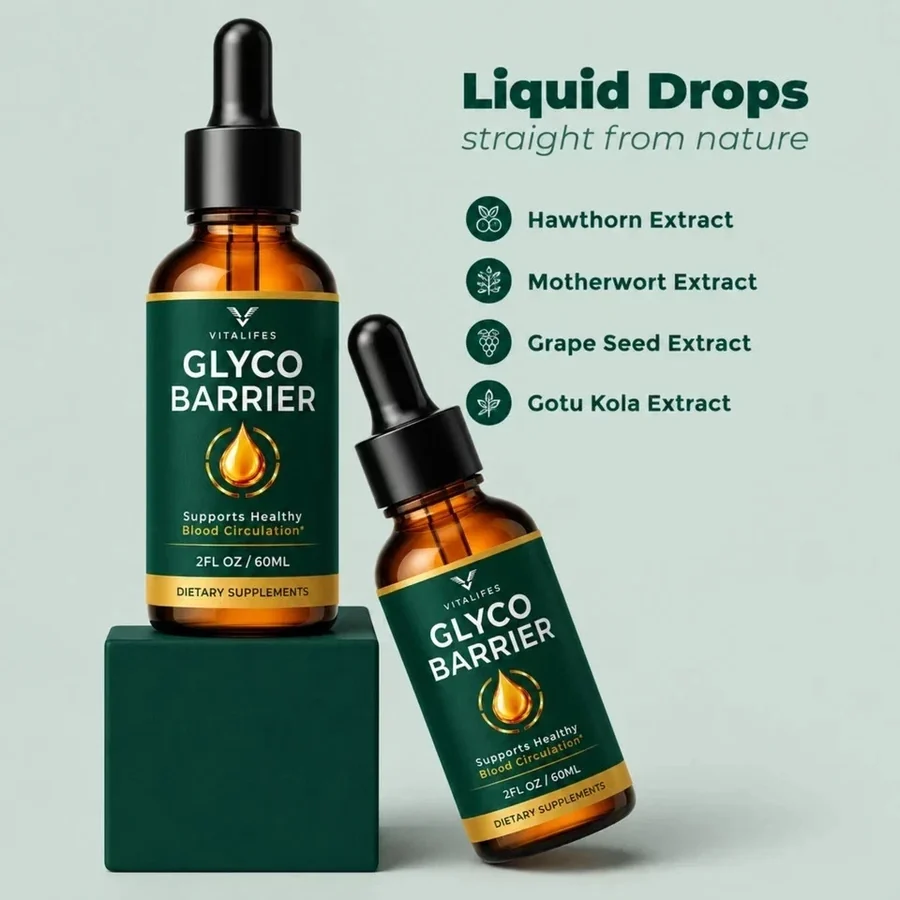
The seller’s square panel is headed “Liquid Drops straight from nature” and names four plants: hawthorn, motherwort, grape seed and gotu kola. The detailed pack names the same four.
The bottle disagrees. Its panel prints six lines inside the blend, and the two extra names are horse chestnut extract and butcher’s broom extract.
When a marketing panel and a Supplement Facts panel disagree, the label wins: it is the regulated surface, and it is what a pharmacist will read back to you.
The omitted pair is the wrong pair to omit. Horse chestnut carries the only genuine controlled-trial record on this label, and the sharpest safety note with it. A buyer checking the marketing panel against a prescription would miss the one that most needed checking.
The honest section
How much of each ingredient is in GlycoBarrier?
| Ingredient, in panel order | Plant part printed | Amount in GlycoBarrier | Research reference elsewhere |
|---|---|---|---|
| 1. Gotu kola extract | leaf | not published | No agreed research dose |
| 2. Chinese hawthorn extract | fruit | not published | Trials commonly use standardised leaf-and-flower extract, hundreds of milligrams daily |
| 3. Horse chestnut extract | not printed | not published | Standardised seed extract, typically taken daily for weeks in trials |
| 4. Motherwort extract | not printed | not published | No agreed research dose |
| 5. Butcher’s broom extract | root | not published | No agreed research dose |
| 6. Grape seed extract | not printed | not published | Trials have used a wide range; no single agreed amount |
The research column describes work on the plant in general, usually a standardised single extract. None of it was run on this product.
A column saying the same thing six times looks like a mistake. It is the point: six named plants, three named parts, six amounts that exist nowhere in our sources.
What is published is the total — 121 mg per 2 mL serving, 242 mg across a day. Split evenly, which the ordering rule says it is not, each extract would carry a sixth of that — against published hawthorn work using hundreds of milligrams of one standardised extract.
named on the panel
not for any one of them
three are left blank
published anywhere
Reading a blend
What “descending order by weight” actually tells you
A proprietary blend is a mostly-closed box with one hinge: ingredients inside it must be listed in descending order by weight. That rule does all the work below.
Gotu kola is the largest share. Nothing in the bottle weighs more — and it is also the ingredient with the thinnest mainstream evidence file here, since NCCIH’s Herbs at a Glance index runs to about sixty herbs and gotu kola is not one of them.
Grape seed is the smallest. NCCIH reports that research has not shown grape seed extract helpful for any health condition, so the smallest share going there is the sensible way round.
Horse chestnut sits third of six. Neither largest nor smallest, and the rule tells you nothing else.
Nothing tells you where the gaps fall. A formula that is nearly all gotu kola and a trace of everything else prints identically to six near-equal shares. That is the whole limitation, and it is the point at which this panel stops being useful.
What the brackets do
Three plant parts printed, three left blank
Three ingredients carry a plant part in brackets: gotu kola (leaf), Chinese hawthorn (fruit) and butcher’s broom (root). Three do not: horse chestnut, motherwort and grape seed.
For grape seed the omission is near harmless, since the name contains the part. For motherwort it is untidy. For horse chestnut it is the most consequential blank on this label.
NCCIH states that raw horse chestnut seeds, bark, flowers and leaves are unsafe to swallow because they contain a toxic component, and that a properly processed standardised extract has that component removed and is considered safe for short-term use. The same page describes a 2012 review of horse chestnut seed extract improving symptoms of chronic venous insufficiency.
Both the evidence and the warning attach to one preparation of one part. This panel prints two words and no part, no ratio, no standardisation. Nothing in our sources says the bottle contains anything unsafe; we are saying an ordinary label line is absent where it would have carried meaning.
The question we would ask first
Which part of the horse chestnut plant the extract comes from, and whether it is standardised. The order desk is on +1 (302) 200-3480. No page supplied to us contains the answer.
Beyond the blend
The seven other ingredients in GlycoBarrier
| Ingredient | What it is doing | Our reading |
|---|---|---|
| RO water | Base | Reverse-osmosis water, the bulk of the liquid. |
| Vegetable glycerin | Carrier | Sweet and viscous. It holds the extracts in suspension, and it is why the bottle must be shaken rather than swirled. |
| Natural flavor | Taste | A regulated term for flavouring from a natural source. Which source is not printed. |
| Sodium benzoate | Preservative | A standard preservative for water-based liquids. |
| Potassium sorbate | Preservative | Its usual partner, covering a wider range of spoilage. Two preservatives in a dropper product is normal, not a red flag. |
| Malic acid | Acidity regulator | Found naturally in apples. Holds the pH steady, which is part of how the preservatives work. |
| Sucralose | Sweetener | Non-nutritive; there is no sugar on this panel. If you avoid sucralose, this is the line to notice. |
Seven names, printed in full. Nothing animal-derived is listed, which makes the “vegan friendly” line on the seller’s panel credible rather than decorative. The heading above this list is itself misprinted on the artwork as “Otter Ingredients”, a signal about the printing rather than the liquid.
Questions
GlycoBarrier FAQ: ingredients questions
What is in the proprietary blend?
Six extracts, in the order the panel prints them: gotu kola extract (leaf), Chinese hawthorn extract (fruit), horse chestnut extract, motherwort extract, butcher’s broom extract (root) and grape seed extract. The blend total is 121 mg per 2 mL serving.
How much of each ingredient is in it?
Not published. “Proprietary Blend” means the manufacturer declares one total instead of six amounts. US rules allow it, provided the ingredients are listed in descending order by weight - which tells you gotu kola is the largest share and grape seed the smallest, and nothing more.
Is 121 mg a lot?
No. Split six ways it is small. Published human work on horse chestnut uses a standardised seed extract taken daily for weeks, and hawthorn trials use hundreds of milligrams of a single standardised extract. The whole GlycoBarrier blend is 121 mg.
What are the other ingredients?
RO water, vegetable glycerin, natural flavor, sodium benzoate, potassium sorbate, malic acid and sucralose. Sodium benzoate and potassium sorbate are the preservatives; sucralose is the sweetener; malic acid is the acidity regulator. All seven are printed on the panel.
Is horse chestnut a real concern?
It is the ingredient to understand properly. NCCIH states that raw horse chestnut seeds, bark, flowers and leaves are unsafe to swallow because they contain a toxic component, and that properly processed standardised extract has that component removed and is considered safe for short-term use. This label prints “Horse Chestnut Extract” and nothing else - no plant part, no standardisation. We would ask the order desk before a first bottle.
References
Sources for this page
- National Center for Complementary and Integrative Health. Hawthorn: Usefulness and Safety. www.nccih.nih.gov. Accessed September 22, 2026.
- National Center for Complementary and Integrative Health. Horse Chestnut: Usefulness and Safety. www.nccih.nih.gov. Accessed September 22, 2026.
- National Center for Complementary and Integrative Health. Grape Seed Extract: Usefulness and Safety. www.nccih.nih.gov. Accessed September 22, 2026.
- National Center for Complementary and Integrative Health. Herbs at a Glance. www.nccih.nih.gov. Accessed September 22, 2026.
- NIH Office of Dietary Supplements. Botanical Dietary Supplements: Background Information. ods.od.nih.gov. Accessed September 22, 2026.
Next
Keep reading
The whole panel, transcribed
Every line on the back and side of the bottle, including six misprints.
Read it →How the six fit together
Three traditions, one mechanism map, and why a map is not a claim.
Read it →Safety and interactions
The hawthorn, grape seed and horse chestnut checks, in plain terms.
Read it →Order GlycoBarrier from the official page
Six named botanicals inside a 121 mg blend, 30 servings a bottle at 1 mL twice daily. Read the amount table above first — the split is the one thing this label does not publish. Order desk +1 (302) 200-3480.
Price and money-back window on the listing · ships from inside the US · order desk +1 (302) 200-3480