Authorized retailer · USA Authorized GlycoBarrier Retailer 121 mg blend · 30 servings a bottle 1 mL twice daily +1 (302) 200-3480 Lot GLY-26/GO-2426

Free reading

The Circulation Supplement Guide

What the phrase means in a US shop, which plants keep appearing, what the law lets any of them say, and where the honest answer stops being a supplement.

Written and reviewed by the GlycoBarrier Editorial Desk · Last updated September 22, 2026

Quick answer

A circulation supplement is a retail category rather than a regulated class. Everything on that shelf is legally a dietary supplement: it may make “supports” claims about normal body function, must carry the FDA disclaimer, and may never claim to treat a disease. Five botanicals account for most of the shelf, and only three of them have federal consumer pages. Daily Values are not established for botanicals, so the panel prints an asterisk instead of a percentage. And if a leg is changing, the answer is a clinician rather than a shelf.

The category

What a circulation supplement actually is

A retail grouping with a legal floor underneath it, and no evidence standard holding it together.

“Circulation supplement” is a shelf category, not a legal one and not a medical one. No US regulation defines it. What defines it is the promise on the front of the box: something about blood flow, leg comfort, cold hands, or the general idea of keeping things moving.

Underneath, there is only one category in law. Everything on that shelf is a dietary supplement, regulated as a food rather than as a drug. The FDA’s consumer page states the consequence plainly: supplements are not reviewed for safety and effectiveness before sale, and responsibility for both sits with the firm selling them.

So the category is held together by the claim on the front and by a small, repetitive group of botanicals — not by evidence. Two boxes on the same shelf can differ tenfold in strength and entirely in preparation. You are comparing two guesses, not two versions of one thing.

The usual names

The botanicals that keep appearing

Five plants account for most of this shelf. Three have federal health pages you can read in ten minutes; two do not.

Horse chestnut

The strongest research record here. NCCIH describes a 2012 review of horse chestnut seed extract in chronic venous insufficiency: it improved symptoms such as leg pain, swelling and itching, and one study found it comparable to compression stockings. The same page warns that raw seeds, bark, flowers and leaves are unsafe to swallow, and that properly processed standardised extract has that component removed.

Butcher’s broom

A low Mediterranean evergreen whose root and rhizome are used; a standard part of European venous-tone preparations, very often paired with horse chestnut. Not among the roughly sixty herbs in NCCIH’s Herbs at a Glance index.

Hawthorn

A thorny shrub in the rose family, used as leaf, flower or fruit depending on the tradition. NCCIH reports it has been studied for heart failure and blood pressure, that some studies suggest benefit as an add-on, and that the evidence is not strong enough to settle it. It can interact with heart medicines including digoxin.

Gotu kola

A creeping plant from wet ground across Asia; the leaf is the part used. The traditional circulation herb of the group. Like butcher’s broom, it is absent from NCCIH’s Herbs at a Glance index.

Grape seed

Made from the seeds left after winemaking, and rich in proanthocyanidins. NCCIH’s page is unusually direct: it has been studied for conditions including cardiovascular disease, and research has not shown it helpful for any health condition. Generally well tolerated; may slow blood clotting.

Two more names on the same shelf

Diosmin and hesperidin are flavonoid compounds associated with citrus and appear widely in venous-support products. Ginkgo is the other name that keeps turning up wherever blood flow is discussed. Both are described here only as things you will see printed: no federal source is cited for either, no claim and no amount is made for either, and neither is in the product sold here.

The reason to know the list is pattern recognition. When five products name the same plants, the difference between them is the preparation, the plant part, the standardisation and the amount.

Claims

What US law lets these products say

A dietary supplement sold in the United States may make a structure/function claim: a statement about how an ingredient affects the normal structure or function of the body. “Supports healthy blood circulation” is the model example, which is why nearly every product here uses the word supports.

That claim carries a price. The label must show the disclaimer in full: “These statements have not been evaluated by the Food and Drug Administration. This product is not intended to diagnose, treat, cure or prevent any disease.” A supports-style claim with no disclaimer anywhere on the package means something has been skipped.

What the same product may not do is make a disease claim. It may not say it treats varicose veins, lowers blood pressure, dissolves a clot or reverses cardiovascular disease. Those are drug claims, and the test is a useful one: the more disease-shaped the promise, the less the seller respects the line.

Two points sit underneath. No dietary supplement is FDA approved, and a seal reading “FDA-registered facility” describes a registration rather than an approval of the contents. And the NIH Office of Dietary Supplements is blunt about who is responsible for a supplement being what it says: the firm selling it.

The footnote

Why the Daily Value says “not established”

Turn any of these products round and you will find an asterisk beside the botanical rows and a footnote reading “Daily Value Not Established”. It is not a hedge.

A Daily Value is a reference figure, set for nutrients where an agreed intake exists — vitamin C, iron, calcium. Botanical extracts have no such figure, because no US reference intake exists for hawthorn or butcher’s broom. No yardstick, so no percentage, so an asterisk and an explanation.

The NIH Office of Dietary Supplements covers this in its background material on botanicals. With no reference intake there is no official answer to “is this enough?” A botanical amount can only be judged against the amount used in published research on that preparation — which needs the label to print an amount at all.

So the footnote is honest, normal and useless for deciding whether to buy. It says the yardstick does not exist.

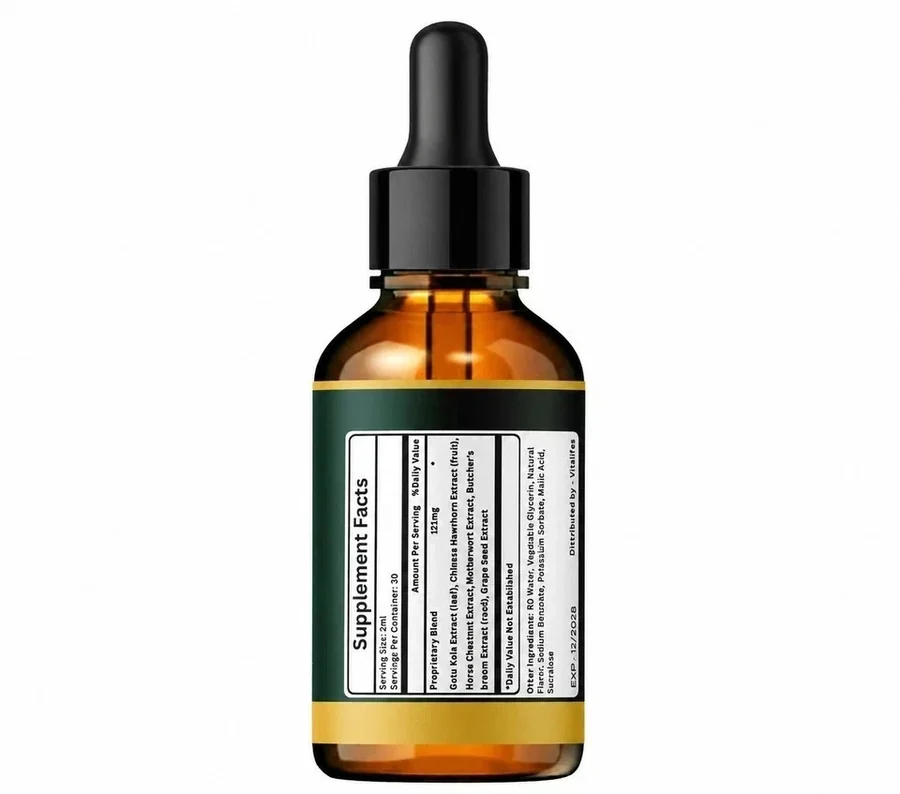
A Supplement Facts panel on a circulation supplement showing a proprietary blend and a Daily Value Not Established footnote
A panel from this category, photographed off the bottle. The asterisk beside the blend row points at “*Daily Value Not Established” — standard on a botanical label.

Reading the numbers

Proprietary blend or full panel

One word on the panel decides this.

A proprietary blend

One total for a named group, with the members listed underneath and no individual amounts. It is legal and extremely common, and it costs you the ability to compare any single ingredient against published research.

It still tells you one thing. Blend members must be listed in descending order by weight, so the first name is the largest share and the last is the smallest. If the ingredient you came for is at the bottom, you have learned something real.

A full panel

Every ingredient carries its own declared amount, so you can hold any row against published work on that preparation and reach your own conclusion in a minute. Products that publish one are in the minority.

And the third case

Some products print no numbers at all. Against that, a declared blend total is a genuine step up: it gives you the scale, if not the split. Rank the three in that order.

Format

Capsules, liquids and gummies

Three ways to take the same plants. The differences are practical, not pharmacological.

Formats judged on what is actually different about them, rather than on absorption claims.
FormatWhat it is good atWhat it costs you
CapsulesThe default. Easy to dose exactly, easy to carry, no taste, and the format most standardised single-ingredient extracts are sold in.You have to swallow it, which stops more people than the category admits.
Liquids and dropsNothing to swallow, a dropper held under the tongue, and three printed numbers you can check against each other in ten seconds.It has to be shaken, because extracts settle; the dropper has to be measured rather than counted; and most liquids need a sweetener and preservatives.
GummiesThe format people actually finish, which matters for anything taken daily over weeks.Sugar or a sugar alcohol, less room for active ingredients, and as a rule the weakest labels on the shelf.

No format absorbs a botanical better than another in any way this site can evidence. Pick the one you will still be taking in week six.

The check only liquids let you run

Volume on the front, serving size on the panel, servings per container. Divide the first by the second and you should get the third. When it works, somebody proofread the label; when it does not, you have found a fact about the company rather than about the plant.

The boundary

Where the shelf stops and a clinician starts

MedlinePlus, the US National Library of Medicine’s consumer service, covers varicose veins as a medical topic: a condition with causes, medical options and a clinician attached to it. The American Heart Association, describing cardiovascular disease, sets out a group of conditions in which plaque narrows the arteries and restricts blood flow. Between them those two pages cover much of what brings people to this shelf, and neither is answered by a bottle.

Notice what that does to the best piece of research here. Horse chestnut seed extract was studied in chronic venous insufficiency — a diagnosis made by a clinician, not a feeling at the end of a long day.

When the answer is a clinician, not a shelf

If a leg changes quickly, if swelling arrives in one leg and not the other, or if a vein or the skin over it changes appearance, that is a question for a doctor now rather than a category to shop in. If you take a blood thinner, a heart medicine or blood-pressure medicine, the conversation happens before the first dose: hawthorn interacts with heart medicines including digoxin, and grape seed extract may slow blood clotting. If you are pregnant or breastfeeding, most of this shelf has no safety data for you either way.
Questions

GlycoBarrier FAQ: circulation guide questions

Will it treat varicose veins?

No. This is a dietary supplement, not a treatment for any condition, and the label carries the FDA footnote saying so. MedlinePlus covers varicose veins as a medical topic with medical treatments; if that is what you are dealing with, a clinician will do more than drops.

What does “Daily Value Not Established” mean?

It means no US reference intake exists for these botanicals, so the panel cannot print a percentage. It is a normal and honest line on a herbal label, not a warning - but it does mean there is no official yardstick to measure 121 mg against.

Is it FDA approved?

No dietary supplement is. The FDA is not authorised to approve supplements for safety and effectiveness before they are sold. A seal reading “FDA-registered facility” describes a factory’s registration, not this product.

Is horse chestnut a real concern?

It is the ingredient to understand properly. NCCIH states that raw horse chestnut seeds, bark, flowers and leaves are unsafe to swallow because they contain a toxic component, and that properly processed standardised extract has that component removed and is considered safe for short-term use. This label prints “Horse Chestnut Extract” and nothing else - no plant part, no standardisation. We would ask the order desk before a first bottle.

Is there a study on GlycoBarrier?

No. Every reference on this site is about a single ingredient, usually at a different amount and in a different preparation. None of them tested this bottle.

References

Sources for this page

  1. National Center for Complementary and Integrative Health. Horse Chestnut: Usefulness and Safety. www.nccih.nih.gov. Accessed September 22, 2026.
  2. National Center for Complementary and Integrative Health. Hawthorn: Usefulness and Safety. www.nccih.nih.gov. Accessed September 22, 2026.
  3. National Center for Complementary and Integrative Health. Grape Seed Extract: Usefulness and Safety. www.nccih.nih.gov. Accessed September 22, 2026.
  4. National Center for Complementary and Integrative Health. Herbs at a Glance. www.nccih.nih.gov. Accessed September 22, 2026.
  5. MedlinePlus, U.S. National Library of Medicine. Varicose Veins. medlineplus.gov. Accessed September 22, 2026.
  6. American Heart Association. What Is Cardiovascular Disease?. www.heart.org. Accessed September 22, 2026.
  7. U.S. Food and Drug Administration. Information for Consumers on Using Dietary Supplements. www.fda.gov. Accessed September 22, 2026.
  8. NIH Office of Dietary Supplements. Botanical Dietary Supplements: Background Information. ods.od.nih.gov. Accessed September 22, 2026.

See the product this guide is published alongside

Liquid drops, 2 FL OZ / 60ML a bottle, 30 servings at 1 mL twice daily, with a 121 mg proprietary blend of six botanicals. Price and window are on the listing. Order desk +1 (302) 200-3480.

Price and money-back window on the listing · ships from inside the US · order desk +1 (302) 200-3480

GlycoBarrier — 121 mg blend, 30 servings a bottle Money-back window on the listing · price shown at checkout
Order now