Official product information
GlycoBarrier Supplement Facts: The Whole Panel, Transcribed
Every line on the back and side of the bottle, word for word — the blend, the six extracts, the seven other ingredients, the directions, the warnings and the six misprints you will see yourself.
Written and reviewed by the GlycoBarrier Editorial Desk · Last updated September 22, 2026
Quick answer
The GlycoBarrier Supplement Facts panel prints a serving size of 2 ml, 30 servings per container and a Proprietary Blend 121 mg with a Daily Value of “*” and the footnote “*Daily Value Not Established”. Six botanical extracts are named inside the blend and seven other ingredients below it. The side panel prints the directions, the caution, three warnings and the FDA footnote. Everything here is transcribed off the bottle artwork supplied to us.
The back of the bottle
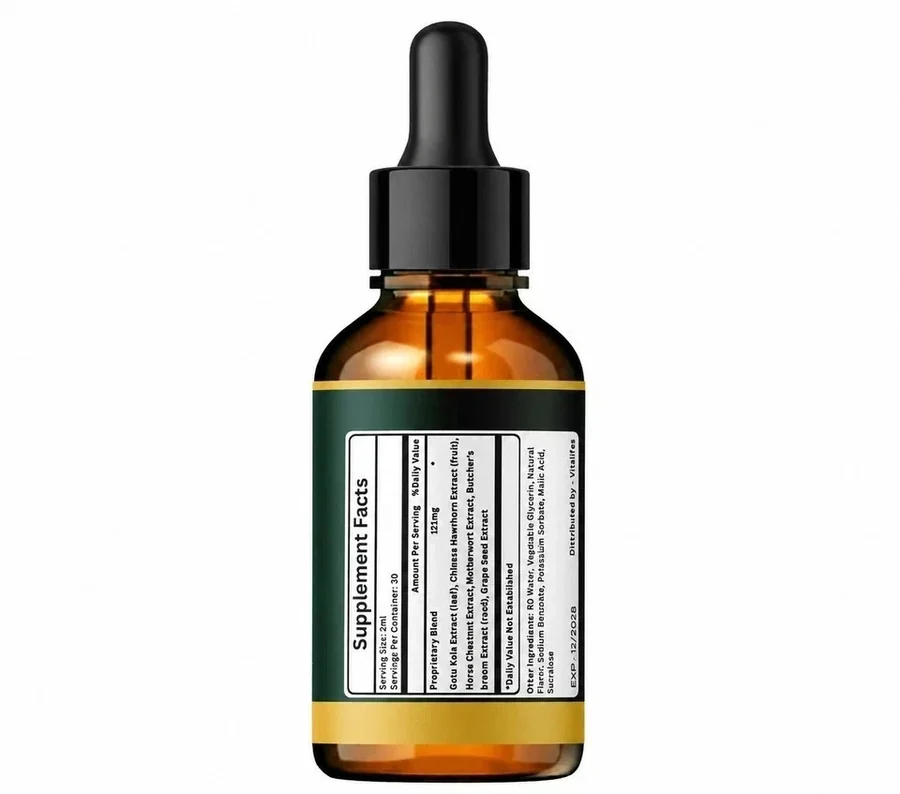
The GlycoBarrier Supplement Facts panel, line by line
Every line the panel carries, in the order it carries it. Nothing summarised, nothing added.
The top of the panel
- Supplement Facts
- Serving Size: 2ml
- Servings Per Container: 30
- Amount Per Serving · %Daily Value
- Proprietary Blend — 121mg — *
The six extracts inside the blend
- Gotu Kola Extract (leaf)
- Chinese Hawthorn Extract (fruit)
- Horse Chestnut Extract
- Motherwort Extract
- Butcher’s Broom Extract (root)
- Grape Seed Extract
Below the rule
- *Daily Value Not Established
- Other Ingredients: RO Water, Vegetable Glycerin, Natural Flavor, Sodium Benzoate, Potassium Sorbate, Malic Acid, Sucralose
- Distributed by - Vitalifes
- EXP 12/2028
Correct spellings are used above; the printed misprints are listed further down this page.
The side of the bottle
The directions and warnings panel
Suggested use, word for word
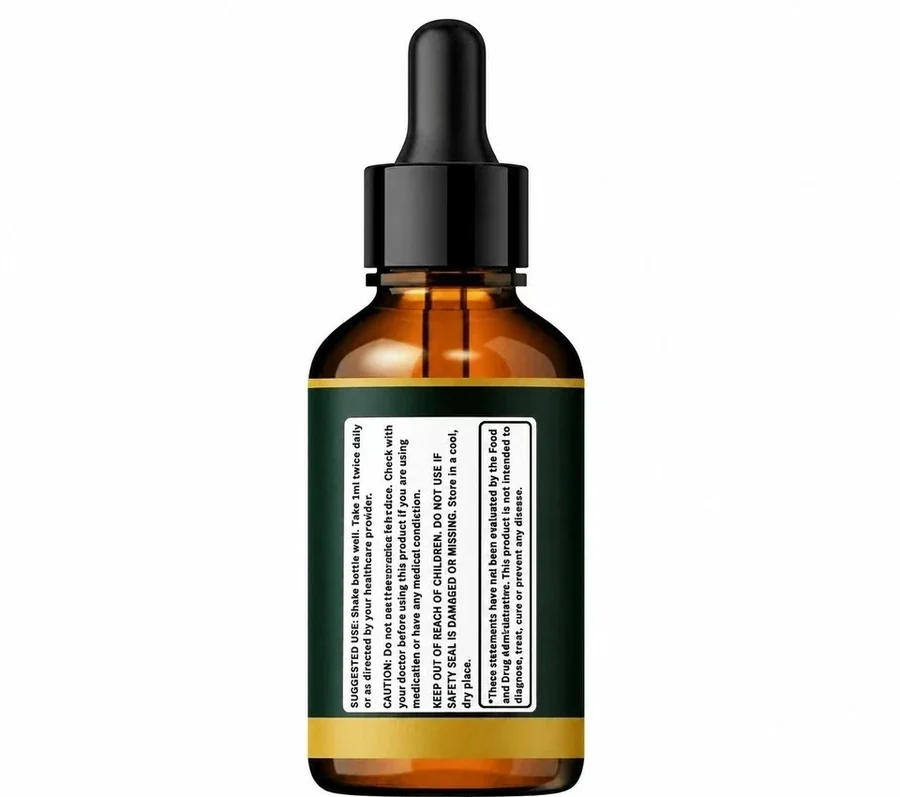
“SUGGESTED USE: Shake bottle well. Take 1ml twice daily or as directed by your healthcare provider.”
Two sentences, and both do work. The first is a handling instruction tincture buyers routinely skip. The second gives an amount, a frequency and a deferral to a clinician, which is more than many dropper products manage.
Caution, word for word
“CAUTION: Do not exceed the recommended dose. Check with your doctor before using this product if you are using medication or have any medical condition.”
Warnings, word for word
- KEEP OUT OF REACH OF CHILDREN.
- DO NOT USE IF SAFETY SEAL IS DAMAGED OR MISSING.
- Store in a cool, dry place.
The FDA footnote
The panel carries the standard statement that these statements have not been evaluated by the Food and Drug Administration and that the product is not intended to diagnose, treat, cure or prevent any disease. It is printed with a misprint inside it.
A real strength
The bottle arithmetic, and why it is worth checking
Here is a check that takes fifteen seconds and that a surprising number of dropper labels fail. Divide the bottle volume by the serving size and compare the answer with the declared servings per container.
60 mL ÷ 2 mL = 30. The panel declares 30 servings per container. They agree.
Follow it to the dose and it still agrees: 1 mL twice daily is 2 mL a day, one serving a day, 30 days. One bottle is one month. Four numbers printed on three faces of the same bottle all describe the same thirty days.
We labour this because the failure mode is common. A label whose dose will not divide into its own bottle was assembled from a template by someone who never held it. When the arithmetic does check out, somebody proofread the numbers — which, given the spelling elsewhere on this label, is genuinely interesting.
What the arithmetic does not do
It says nothing about whether 121 mg of blend is a useful amount of anything. A label can be internally consistent and still be modest. Two separate questions, and this section answers only the first.
printed on the panel
and the arithmetic agrees
the panel’s only amount
printed in full
Printing quality
Six misprints on the label artwork
What is wrong with the printing, what that is fair evidence of, and what it is not.
| As printed | As it should read | Where it appears |
|---|---|---|
| “Chinesa Hawhorn Extract” | Chinese Hawthorn Extract | Two letters dropped from one ingredient name on the panel. |
| “Horse Cheatnut Extract” | Horse Chestnut Extract | A transposed pair in the second botanical. |
| “Otter Ingredients” | Other Ingredients | The heading above the excipient list. |
| “Butcher’s broom Extract” | Butcher’s Broom Extract | Lower-case where the rest of the list is capitalised. |
| “have nal been evaluated” | have not been evaluated | Inside the FDA disclaimer itself, on the side panel. |
| “RRODUCTILAB TESTED” | Product / lab tested | On a roundel in the Blood-Drops Formula panel. |
We publish this because you are going to see it. A site describing this bottle without mentioning the spelling would be describing a different bottle.
Now the important half. Misprinted artwork is a signal about printing, not evidence about the liquid. A dropped letter tells you nothing about what is in the bottle or how it was blended. Proofreading and manufacturing are different departments, often different companies, and treating a typo as a contamination story would be as dishonest as pretending it is not there.
What is fair to take from it is narrower: somebody signed this artwork off without reading it closely, which earns you the right to read the panel closely yourself rather than trusting a marketing square — which is exactly how we found that the marketing square names four botanicals and the label names six.
Two deserve a note. The misprint inside the FDA disclaimer sits in a required legal line that is normally copied verbatim. And a roundel claiming lab testing is misspelled while making the claim, with no document behind it to read.
The honest section
What the panel does not print
Not printed anywhere on this label
- How the 121 mg divides between the six extracts
- Which plant part the horse chestnut extract is made from
- Which plant parts the motherwort and grape seed extracts are made from
- An extract ratio or standardisation for any of the six
- The hawthorn variety, beyond the word “Chinese”
- A manufacturing address — the only line is a distributor line
- A country of origin for any individual ingredient
- Any direction about food, water or time of day
And not published in any source we hold
- A certificate of analysis document. Lot GLY-26/GO-2426 and certificate GLY-2426-26-GO are reference codes with nothing attached to open.
- A pack price. Every figure on this site reads “at checkout”.
- A money-back window length.
- Any published trial of this formula.
- Any published side-effect data for this product.
Why we print the absence
A gap you can see is worth more than a gap that has been written around. Every line above is a question somebody sensibly asks, and the honest answer is the same: it is not on the label, so we do not know.
A method you can reuse
How to read any Supplement Facts panel in ninety seconds
Start with the serving size, not the milligrams
Everything on a panel is quoted per serving, so a big number against a big serving can be a smaller daily amount than a modest number against a small one. Here it is 2 mL, twice, so the day is 242 mg of blend.
Do the volume arithmetic
Bottle volume divided by serving size should equal servings per container. On this bottle it does. When it does not, one of those three numbers is wrong.
Work out whether it is a blend or a list
A blend prints one total; a list prints an amount per ingredient. This is a blend, so the only amount available is 121 mg for all six extracts together.
Use the ordering rule
Inside a blend, ingredients are listed in descending order by weight. Gotu kola is the largest share here and grape seed the smallest. It refuses to tell you anything else.
Read the other-ingredients line properly
Sweeteners, preservatives and allergens live there, and it is the part buyers skip. On this label it is complete.
Check the plant parts and the footnotes
Brackets after a botanical name carry real information. So does “Daily Value Not Established”, which means only that no US reference intake exists for these plants.
Run those six on this bottle and it passes four cleanly, passes the fifth with three plant parts out of six, and stops at the third — where the word “proprietary” always stops a label.
Our reading
What this panel is good at, and where it stops
Two things are true about this label at once, and a page telling you only one would be advertising.
It is a real panel. A declared blend total, a printed serving size, a printed serving count, a printed dose, six named botanicals in weight order, a complete other-ingredients line, a footnote, a best-before date and a distributor line. Plenty of this category publishes a plant photograph and a paragraph.
And it stops at the word “proprietary”. One number for six extracts, three missing plant parts, no standardisation, and a required legal footnote with a typo in it. The strongest research finding near this bottle belongs to a preparation the label does not confirm it uses.
If you are holding a bottle now, two things are worth doing: check the panel against the transcription above line by line, and check the safety seal before you open it. The label is explicit about the second, in capitals, and the order desk on +1 (302) 200-3480 would rather replace a bottle than have you take a chance on one.
Questions
GlycoBarrier FAQ: supplement facts questions
What is GlycoBarrier?
GlycoBarrier is a dietary supplement sold as liquid drops in a 2 fl oz amber glass dropper bottle. The front label reads “VITALIFES / GLYCO BARRIER / Supports Healthy Blood Circulation* / 2FL OZ / 60ML / DIETARY SUPPLEMENTS”. The Supplement Facts panel declares a 121 mg proprietary blend of six botanical extracts.
Who makes GlycoBarrier?
The label’s only manufacturing line reads “Distributed by - Vitalifes”. That is a distributor statement, not a factory address, and no factory is named anywhere in the material supplied to us.
How much liquid is in a bottle?
60 millilitres, printed on the front as “2FL OZ / 60ML”. At the label dose of 1 mL twice daily that is thirty days, which matches the “Servings Per Container: 30” line on the panel exactly.
What does “Daily Value Not Established” mean?
It means no US reference intake exists for these botanicals, so the panel cannot print a percentage. It is a normal and honest line on a herbal label, not a warning - but it does mean there is no official yardstick to measure 121 mg against.
Does it contain sugar?
No sugar is listed. The sweetener named on the panel is sucralose, which is a non-nutritive sweetener. If you are avoiding sucralose specifically, that is worth knowing before you order.
What does the best-before date say?
The panel prints EXP 12/2028. If you are buying six bottles, check that against six months of daily use before you order - the arithmetic is comfortable now, but the date on the bottle you receive is the one that counts.
References
Sources for this page
- U.S. Food and Drug Administration. Information for Consumers on Using Dietary Supplements. www.fda.gov. Accessed September 22, 2026.
- NIH Office of Dietary Supplements. Dietary Supplements: What You Need to Know. ods.od.nih.gov. Accessed September 22, 2026.
- National Center for Complementary and Integrative Health. Using Dietary Supplements Wisely. www.nccih.nih.gov. Accessed September 22, 2026.
- NIH Office of Dietary Supplements. Botanical Dietary Supplements: Background Information. ods.od.nih.gov. Accessed September 22, 2026.
Next
Keep reading
Order GlycoBarrier from the official page
One panel, 30 servings, 121 mg of blend a serving. Prices and the money-back window are printed on the listing rather than here, because neither was supplied to us. Order desk +1 (302) 200-3480.
Price and money-back window on the listing · ships from inside the US · order desk +1 (302) 200-3480