GlycoBarrier blog
How To Read a Dropper Bottle Label
Bottle volume, serving size, servings per container. If those three do not agree, nobody proofread the label.
Start here
The three-number check
Start with arithmetic, before you read a single claim. Three numbers appear on almost every liquid supplement, and they have to agree with each other.
Bottle volume ÷ serving size = servings per container.
On GlycoBarrier the three numbers are 60 mL on the front, a 2 mL serving size on the Supplement Facts panel, and 30 servings per container on the line below it. Sixty divided by two is thirty. It agrees.
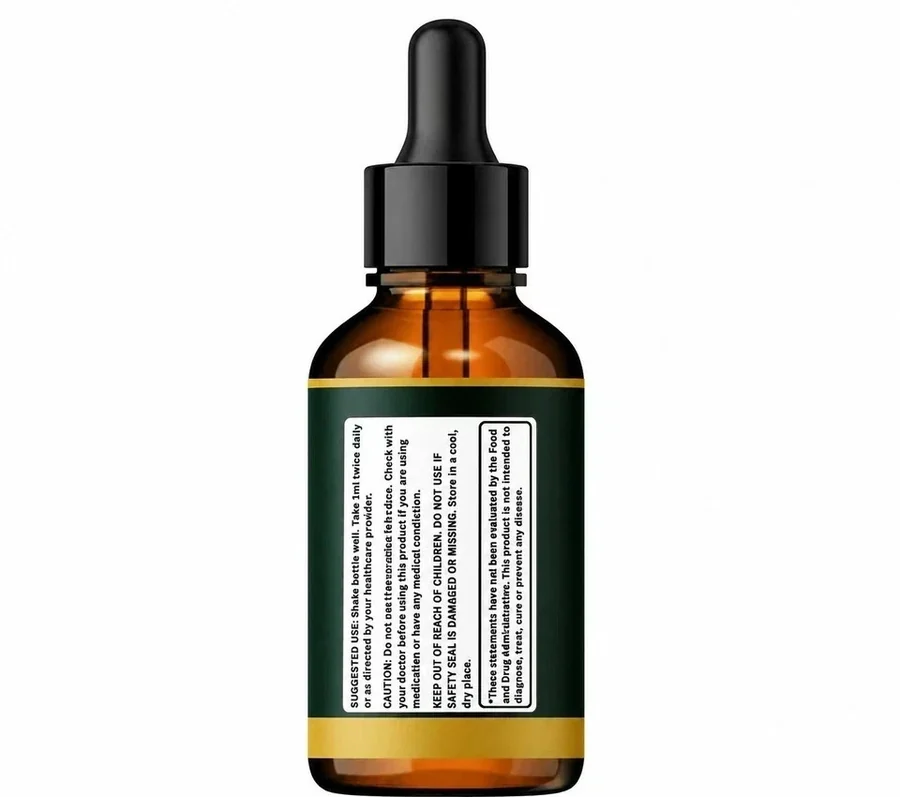
Then check the fourth number, which is the directions. This bottle prints “shake bottle well, take 1ml twice daily”. Two doses of 1 mL is 2 mL a day, which is exactly one declared serving, which makes the bottle last 30 days. Every printed number on the label points at the same month.
Five outcomes
What it catches when it fails
| What you find | What it usually means | What to do |
|---|---|---|
| The three numbers agree, and the directions agree with them | Somebody proofread the panel and the dose instruction against each other | Proceed. GlycoBarrier is in this row |
| The arithmetic is out by a small amount | Rounding, or an overfill, or a typesetting slip | Note it. A small slip on the panel is a small signal about the rest |
| The arithmetic is out by a lot | The serving count and the serving size were written by different people, or one of them was never checked | Ask the seller which figure is right before you buy |
| The directions disagree with the serving size | The panel and the side of the bottle describe different daily amounts, so the container count is wrong for real use | Work the real duration out from the directions |
| One of the three is missing | No serving count, or no serving size, so the bottle cannot be checked at all | Treat a missing number as a failed check |
The arithmetic is not interesting in itself. It is a proxy for whether anybody read the label before it was printed, and a panel nobody proofread is a poor guide to a process nobody supervised.
GlycoBarrier passes this, and a lot of liquid supplements do not. Passing it does not touch the gap on the same panel: the blend is declared as one 121 mg total, and not one of the six extracts inside it has a published amount. That is a real point in the label’s favour and a real gap, on the same piece of paper.
Measuring
The pipette, not the drops
Now the dropper itself, which is where most of the real-world error lives.
A glass pipette with a rubber bulb is a measuring instrument if it has a graduation mark, and a rough guess if it does not. Squeeze the bulb once and release, and a standard pipette of this size fills to roughly 1 mL — but roughly is doing real work there, and the amount depends on how hard you squeezed.
A drop is not a unit. Drop size depends on the bore of the glass, the angle you hold it at, the thickness of the liquid and the temperature of the room. Two droppers from two products will not produce the same drop, and the same dropper will not produce the same drop in January and July. Any instruction counted in drops is an approximation being presented as a measurement.
So use the mark. If your pipette has a graduation, fill to it. GlycoBarrier does not publish a drop count for 1 mL anywhere in our sources, and we are not going to estimate one for you, because the honest answer is that it varies by dropper. If yours has no mark, the order desk is the place to ask.
The first line of the directions
Why shaking is an instruction, not a flourish
“Shake bottle well” is the first thing the directions say, and it is a functional instruction rather than a piece of ritual.
A botanical liquid is not a solution in the way sugar in tea is a solution. Extracts in a water and glycerin base can settle, separate or stratify while the bottle stands, which means the liquid at the top of an unshaken bottle and the liquid at the bottom are not necessarily the same liquid. Draw a pipette from a bottle that has stood on a shelf for a fortnight and you are drawing from whichever layer the pipette reaches.
Shaking redistributes it, so that each 2 mL is as close as it can be to the 121 mg the panel declares. Without it the panel describes the bottle as a whole and not the dose in your hand.
The general reading is simple: when a liquid label tells you to shake, it is telling you the contents settle. That is information about the product, printed on the product.
The list people skip
What the other-ingredients list tells you
Under the blend sits a list most people skip. On this bottle it reads: RO Water, Vegetable Glycerin, Natural Flavor, Sodium Benzoate, Potassium Sorbate, Malic Acid, Sucralose. Every item is doing a job, and the list as a whole describes what kind of liquid this is.
The base
RO water and vegetable glycerin are what the extracts are carried in. Glycerin is the sweet, viscous base used in tinctures made without alcohol, and its presence tells you this is a glycerite rather than an alcohol tincture — which matters to anyone avoiding alcohol, and to anyone comparing this with a product that does use it.
The preservatives
Sodium benzoate and potassium sorbate are preservatives. A water-based liquid needs them or something like them; a bottle you open daily for a month is a bottle you are introducing air into daily for a month. Malic acid is a tart-tasting acid, and natural flavour and sucralose are there for taste, sucralose being a sweetener.
The honest reading is neither alarm nor applause: a water-based, alcohol-free, sweetened glycerite with conventional preservatives, printed openly. The list is useful for spotting the thing you personally avoid, and it only works because it is complete.
The bottle itself
Why the glass is brown
Amber glass is not a styling decision, although it is usually also a styling decision.
Coloured glass filters light. Botanical extracts and the compounds in them can degrade on exposure to light over time, which is why brown and cobalt bottles are conventional for tinctures and why the same bottles carry “store in a cool, dry place” on the side. GlycoBarrier prints exactly that line, along with a best-before of 12/2028.
The practical version: keep it off a sunny windowsill and off a steamy bathroom shelf, and check the best-before against how long the pack you bought will last. Six bottles at one a month is six months of use, and that is arithmetic worth doing before you buy a larger pack rather than after.

Six names, three brackets
Plant parts, and why brackets matter
Look at the brackets after the botanical names. They are the most underrated thing on a supplement panel.
A plant is not one ingredient. Root, leaf, seed, fruit, bark and flower differ in chemistry, and published research is almost always done on one specified part. An ingredient named without a part is an ingredient you cannot match to anything.
On this label three lines print a part: gotu kola “(leaf)”, Chinese hawthorn “(fruit)” and butcher’s broom “(root)”. Three do not. Grape seed is self-describing; horse chestnut and motherwort are genuine blanks.
The horse chestnut blank is the one that matters. The federal summary of the research on that plant is specifically about seed extract, and so is its safety reassurance about properly processed standardised extract. Without the word seed on the panel, a reader cannot line the bottle up against either. Three parts printed out of six is above average for this category, and it is still three blanks.
Summary
The checklist
Eight things, in order, on any dropper bottle in any shop.
One. Volume divided by serving size equals the declared serving count. Two. The directions produce that same serving size per day. Three. There is a printed total weight for whatever is in the blend. Four. Each botanical name carries a plant part in brackets. Five. The other-ingredients list is complete and contains nothing you personally avoid. Six. There is a shake instruction, and you follow it. Seven. There is a best-before date, and it outlasts the pack you are buying. Eight. The pipette has a graduation mark, and you use it instead of counting.
GlycoBarrier passes one, two, three, six and seven cleanly. It passes four on three lines of six. Five is a judgement call that is yours rather than ours, and eight depends on the pipette in the cap you receive.
What none of these checks can do is tell you whether the liquid works. They test the care taken over the document, not the contents of the bottle. Read the label carefully, then read what the research on the plants actually says, and hold the two apart.
References
Sources
- NIH Office of Dietary Supplements. Dietary Supplements: What You Need to Know. ods.od.nih.gov. Accessed September 22, 2026.
- U.S. Food and Drug Administration. Information for Consumers on Using Dietary Supplements. www.fda.gov. Accessed September 22, 2026.
- National Center for Complementary and Integrative Health. Using Dietary Supplements Wisely. www.nccih.nih.gov. Accessed September 22, 2026.
- NIH Office of Dietary Supplements. Botanical Dietary Supplements: Background Information. ods.od.nih.gov. Accessed September 22, 2026.
Order GlycoBarrier from the official page
Liquid drops, 2 FL OZ / 60ML a bottle, 30 servings at 1 mL twice daily. Prices and the money-back window are printed on the listing; the order desk number sits in the footer. No per-ingredient amount is published, and you should know that before you pay.
Price and money-back window on the listing · ships from inside the US · order desk number in the footer