Seven checks
Glyco Barrier Side Effects And Safety: 7 Checks
No side effects are published for Glyco Barrier. That sounds reassuring until you ask why. Seven checks show what is known, and what nobody has measured.
Quick answer
No side effects are published for Glyco Barrier, and no trial of the formula exists to have recorded any. The label says to check with your doctor first if you use medication or have a medical condition. Take extra care with heart medicines, blood thinners, surgery and pregnancy. Adults 18 and over only.
On this page
- Key facts
- What does no side effects published really mean?
- What does the label itself tell you to do?
- Do you take a heart medicine?
- Do you take a blood thinner, or have surgery planned?
- Which horse chestnut is in the bottle?
- Are you pregnant, breastfeeding or under 18?
- What should you do if something feels wrong?
- Which safety facts are published, and which are not?
- Frequently asked questions
- Sources used for this page
- Our view
At a glance
Key facts
- Side effects: none published for this product. No trial of this formula has been published.
- Label caution: Do not exceed the recommended dose. Check with your doctor before using this product if you are using medication or have any medical condition.
- Hawthorn can interact with heart medicines including digoxin (NCCIH).
- Grape seed extract may slow blood clotting, which matters with a blood thinner or before surgery (NCCIH).
- Horse chestnut: the label does not say which plant part or preparation is used.
- Not for anyone under 18, pregnant or breastfeeding. Keep out of reach of children.
Check 1
What does no side effects published really mean?
It means the paperwork is empty. It does not mean the record is clean. No list, no frequency and no case report exists for this product, because no trial of this formula has been published. Nothing was set up to record a problem in the first place.
Think of it as a blank, not a zero. Treat the product as an unknown and use the checks below. If something odd happens after you start, it deserves to be reported even though no list exists to match it against.
Check 2
What does the label itself tell you to do?
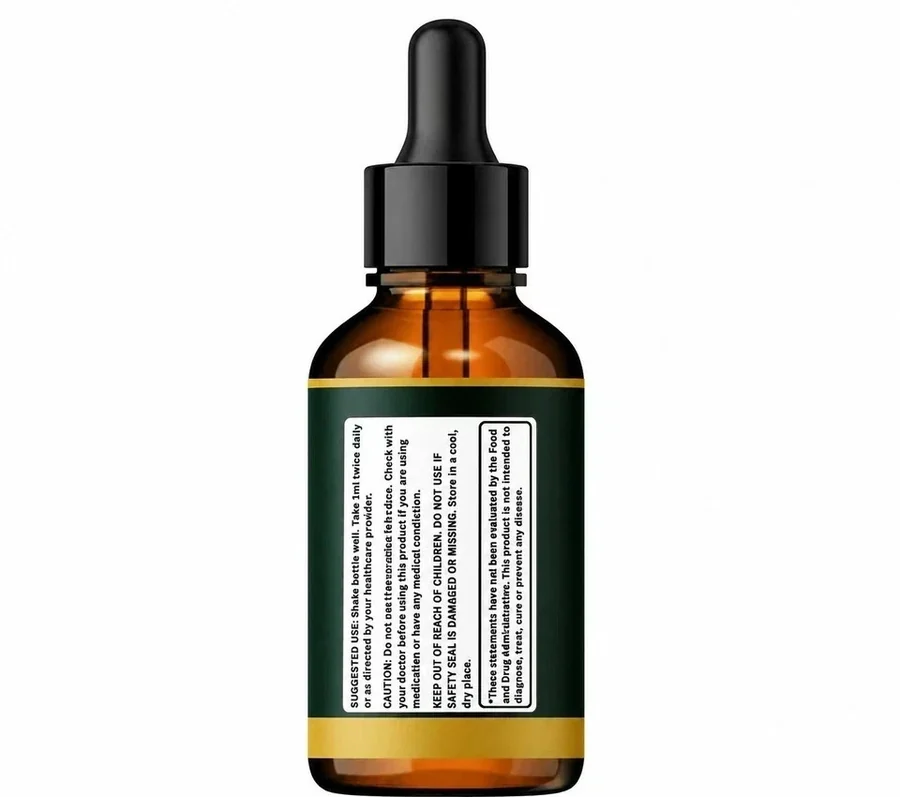
The side panel prints a caution in the bottle's own words: Do not exceed the recommended dose. Check with your doctor before using this product if you are using medication or have any medical condition. Three more lines follow in capitals or plain type: keep out of reach of children, do not use if the safety seal is damaged or missing, and store in a cool, dry place.
Those lines are not added by us. They are the maker's instructions. If you take any regular medicine, the first step is the one the bottle asks for: talk to your doctor or pharmacist.
Check 3
Do you take a heart medicine?
NCCIH warns that hawthorn can clash with heart medicines and names digoxin. Chinese hawthorn is the second extract on the panel, so it is in this blend. NCCIH adds that hawthorn has been looked at for heart failure and blood pressure, and that the proof is not firm enough to decide.
The safe step is simple. Read the six names to your pharmacist and ask whether any of them clashes with what you take. Do not start the drops alongside a heart medicine without asking first.
Check 4
Do you take a blood thinner, or have surgery planned?
NCCIH says grape seed extract may slow blood clotting. It also reports that the extract is generally well tolerated. The clotting point matters if you take a blood thinner or daily aspirin, and it matters before any operation.
Tell the surgical team about every supplement you take, and read the six extract names aloud. Grape seed is the last name on the panel, which means it is the smallest share by weight. A small share is a weaker reason to expect a problem, but not a promise of none.
Check 5
Which horse chestnut is in the bottle?
Most readers skip this check. NCCIH says the raw seed, bark, flowers and leaves of horse chestnut contain a toxic component and are unsafe to swallow. Properly processed, standardised extract has that component taken out, and NCCIH considers it safe for short-term use.
The panel prints Horse Chestnut Extract and stops. There is no plant part and no standardisation. The preparation in the bottle is therefore not published. Ask the order desk before your first dose, and write down the answer with the date.
Check 6
Are you pregnant, breastfeeding or under 18?
Then this product is not for you, because it is sold to adults 18 and over. Motherwort, the fourth extract, is traditionally used to stimulate the uterus, which is a reason to avoid it in pregnancy and not a feature. No safety data exists here for pregnancy or breastfeeding either way.
Keep the bottle where children cannot reach it. It is a sweetened, flavoured liquid in a dropper bottle, and the label says to keep it out of reach of children.
Check 7
What should you do if something feels wrong?
Stop taking it
Do this before anything else. Do not wait to see whether it settles.
Get urgent help if it is serious
Trouble breathing, swelling of the face or throat, chest pain or fainting are emergencies. Call emergency services.
Tell your own clinician
Take the bottle. Read out the six extracts and say that the blend is 121 mg per serving with no split published.
Tell the order desk
Call +1 (302) 200-3480 with your order ID and the lot code from the bottle.
Keep the evidence
Keep the bottle, the box and the seal. Write down the date, the dose and anything else you took that day.
A plain safety note
Glyco Barrier is a dietary supplement, not a drug. It is not FDA approved, and no dietary supplement is. It is not a treatment for any disease. If you take medicine or have a medical condition, ask your doctor before you start. This page is general information, not medical advice.
The short table
Which safety facts are published, and which are not?
| If this is true for you | Ingredient behind it | What to do |
|---|---|---|
| Heart medicine such as digoxin | Chinese hawthorn | Ask a pharmacist before starting |
| Blood thinner, aspirin or planned surgery | Grape seed extract | Ask your doctor and tell the surgical team |
| Pregnant or breastfeeding | Motherwort | Do not use it |
| Unsure which horse chestnut is inside | Horse chestnut | Ask the order desk which preparation it is |
| Any regular medicine or condition | The whole blend | Check with your doctor first, as the label says |
| Side effects, long-term use | Not published | No data exists for this formula |
Questions
Frequently asked questions
Is Glyco Barrier safe to take?
No side effects are published and no trial exists, so safety for you cannot be promised. Several points need care: hawthorn and heart medicines, grape seed extract and clotting, the unspecified horse chestnut preparation and motherwort in pregnancy. Ask your doctor first.
What are the Glyco Barrier side effects?
None are published for this product. That is a gap in the paperwork, not proof that none occur. Stop taking it and speak to your clinician if you notice anything unusual.
Does Glyco Barrier interact with medication?
It can. NCCIH says hawthorn can interact with heart medicines including digoxin, and that grape seed extract may slow blood clotting. The label itself says to check with your doctor if you use medication.
Is it all right to combine Glyco Barrier with blood pressure medicine?
Ask first. Hawthorn has been studied for blood pressure, and butcher's broom has little interaction data. Read the six extract names to your pharmacist before the first dose.
Is it safe while pregnant or breastfeeding?
No. It is not for anyone pregnant or breastfeeding, and motherwort is traditionally avoided in pregnancy. It is also not for anyone under 18.
Is Glyco Barrier safe for people with diabetes?
It is not a diabetes product and nothing on the label claims to affect blood sugar. If you use insulin or another diabetes medicine, speak to the prescriber before starting anything new, and never change a dose because of a supplement.
References
Sources used for this page
- National Center for Complementary and Integrative Health. Hawthorn: Usefulness and Safety. www.nccih.nih.gov
- National Center for Complementary and Integrative Health. Horse Chestnut: Usefulness and Safety. www.nccih.nih.gov
- National Center for Complementary and Integrative Health. Grape Seed Extract: Usefulness and Safety. www.nccih.nih.gov
- National Center for Complementary and Integrative Health. Herbs at a Glance. www.nccih.nih.gov
- U.S. Food and Drug Administration. Information for Consumers on Using Dietary Supplements. www.fda.gov
- National Center for Complementary and Integrative Health. Using Dietary Supplements Wisely. www.nccih.nih.gov
None of these pages tested Glyco Barrier itself. What this page says about safety and interactions comes from the bottle label, the seller’s pack and the pages listed above.
Our verdict
Our view
A small amount of six common botanical extracts sounds mild. That is a guess about averages, and it says nothing about you. The honest summary is that safety here is untested, not proven.
Four groups should slow down: people on heart medicine, people on a blood thinner or facing surgery, anyone pregnant or breastfeeding, and anyone who cannot find out which horse chestnut is in the bottle. A short talk with a pharmacist costs nothing and answers most of it.
Last updated November 4, 2026